

Why Patients Still Choose Independent Optometrists Over Large Optical Chains
The global eye care industry is undergoing a period of rapid consolidation. Corporate optical chains, vertically integrated eyewear conglomerates, and private equity-backed healthcare organisations continue to expand their influence across the vision care sector.

The global eye care industry is undergoing a period of rapid consolidation. Corporate optical chains, vertically integrated eyewear conglomerates, and private equity-backed healthcare organisations continue to expand their influence across the vision care sector. Yet despite these developments, independent optometrists remain the preferred choice for a substantial majority of patients.
Recent industry data show that 77% of patients prefer receiving eye care from an independent optometrist rather than a corporate-owned provider, while 57% believe the quality of care delivered in private practice is superior. Patients report stronger trust, better doctor-patient relationships, and greater confidence in clinical recommendations when receiving care from independent providers.¹
This raises an important question: if large organisations possess greater purchasing power, larger marketing budgets, sophisticated technology infrastructure, and extensive retail networks, why do patients continue to choose independent practices?
The answer lies in one of the most consistent findings in healthcare research: patients value continuity, trust, personalised communication, and long-term relationships. These are precisely the strengths upon which independent optometry has traditionally been built.
This article examines the changing landscape of eye care, reviews the evidence behind patient preference for independent providers, and explores how technology platforms such as ASIRA can help independent practices preserve their greatest strengths while competing effectively in an increasingly consolidated marketplace.
The Global Consolidation of Eye Care
Few healthcare sectors have experienced consolidation on the scale seen within modern eye care.
Globally, the vision care market exceeds USD 100 billion annually and is projected to continue growing rapidly over the coming decade.² As the market has expanded, ownership structures have changed dramatically. Large corporations increasingly control multiple components of the eye care ecosystem, including frame manufacturing, lens production, retail distribution, insurance networks, and wholesale supply chains.²
The most visible example is Essilor Luxottica. Through ownership of lens manufacturers, eyewear brands, retail chains, and managed vision care networks, the company exerts influence across virtually every stage of the patient journey, from examination to eyewear purchase.
At the same time, private equity investment has accelerated consolidation within both ophthalmology and optometry. Analysis published in Ophthalmology identified 245 acquisitions involving ophthalmology and optometry practices between 2012 and 2019, with acquisition activity increasing substantially during the latter years of the study.³ Subsequent research demonstrated continued growth, with nearly 950 ophthalmologists and optometrists acquired by private equity-backed organisations between 2019 and 2021 alone.⁴
Industry analysts expect this trend to continue throughout 2026 and beyond.⁵
From a business perspective, the appeal is obvious. Large organisations benefit from economies of scale, centralised procurement, national advertising campaigns, integrated supply chains, sophisticated analytics, dedicated management teams, and access to investment capital.
Given these advantages, many observers predicted that independent optometry would gradually lose relevance. The evidence suggests otherwise.
Independent Practices Continue to Command Patient Loyalty
Despite decades of consolidation, independent optometry remains remarkably resilient.
Bain & Company reported that independent optometry continues to account for approximately 50% of overall vision care market share despite increasing competition from retail chains and online providers.⁶ More recent industry analyses suggest that independent practitioners continue to account for approximately 53% of patient share within primary eye care, while corporate organisations account for approximately 32%.¹
This distinction is important. Corporate providers often dominate retail sales, while independent providers continue to dominate patient relationships. Those are not the same thing.
Patients may purchase eyewear from a chain retailer. However, when it comes to healthcare decisions, many continue to prefer receiving care from a clinician they know and trust.
Why Patients Prefer Independent Optometrists
The strongest evidence supporting independent optometry is not market share. It is patient preference.
A 2025 industry analysis reported that:
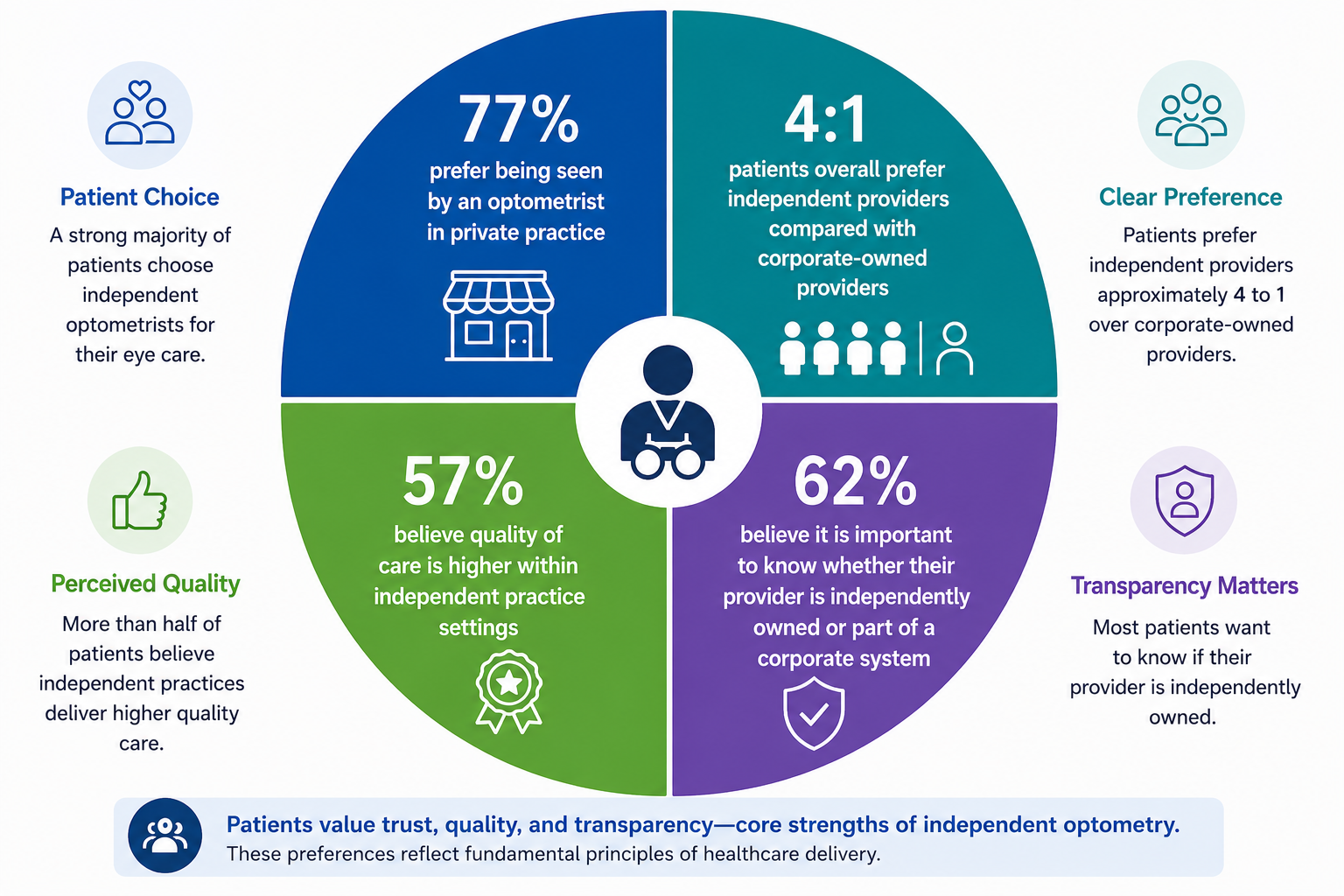
- 77% of patients prefer being seen by an optometrist in private practice.
- Patients overall prefer independent providers approximately 4:1 compared with corporate-owned providers.
- 57% believe quality of care is higher within independent practice settings.
- 62% believe it is important to know whether their provider is independently owned or part of a corporate system.¹
These findings are remarkably consistent with broader healthcare research. The reasons patients choose independent providers extend beyond convenience, pricing, or location. They are rooted in fundamental principles of healthcare delivery.
The Science of Continuity of Care
One of the most extensively studied concepts in healthcare is continuity of care. Continuity refers to the ongoing therapeutic relationship between a patient and a healthcare provider over time. Multiple systematic reviews have demonstrated associations between continuity of care and improved patient satisfaction, increased trust, improved treatment adherence, reduced healthcare utilisation, lower hospitalisation rates, and even lower mortality rates.⁷⁻¹²
A systematic review published in Family Practice found a consistent positive relationship between continuity and patient satisfaction across a wide range of healthcare settings.⁹ Similarly, Saultz and Albedaiwi's influential review in Annals of Family Medicine concluded that higher levels of interpersonal continuity were consistently associated with improved patient satisfaction.¹⁰
More recent studies continue to support these findings. Research published in 2024 reported that continuity of care is associated with improved patient satisfaction, increased trust in healthcare providers, improved adherence to recommended care, and lower healthcare costs.¹¹
For eye care, these findings are particularly relevant. Many ocular conditions require long-term monitoring rather than one-time treatment.
Examples include:
- Glaucoma
- Diabetic retinopathy
- Myopia progression
- Keratoconus
- Dry eye disease
- Contact lens management
- Post-operative care
The ability to see the same clinician repeatedly over months or years allows subtle clinical changes to be recognised more effectively while strengthening patient confidence and engagement. Independent practices are uniquely positioned to provide this form of continuity.
The Most Valuable Asset in Healthcare is Trust
Healthcare is fundamentally different from retail. Patients often lack the technical knowledge required to independently evaluate clinical decisions. As a result, trust becomes one of the most important factors influencing healthcare utilisation. Patients may not remember every clinical explanation, but they remember whether they trusted the person delivering it.
Independent practices naturally foster trust because relationships develop over time. Patients become familiar not only with the practitioner but also with reception staff, technicians, and dispensing teams. The practice becomes part of the local community. This relational model creates an environment in which recommendations are perceived as being driven by clinical need rather than commercial objectives. Research consistently shows that trust improves treatment adherence, communication quality, patient satisfaction, and long-term retention.⁷⁻¹²
In an era where patients increasingly seek personalised healthcare experiences, trust has become one of the most important competitive advantages available to independent practitioners.
The Economics of Patient Loyalty
Patient loyalty is not only clinically beneficial. It is economically powerful. Acquiring new patients is significantly more expensive than retaining existing ones. Long-term patients are more likely to attend recall appointments, accept recommended treatments, purchase eyewear from the practice, refer family members, leave positive reviews, and remain engaged over many years.
This is especially important within optometry because patient lifetime value can extend across decades. A child beginning myopia management today may continue requiring eye care services throughout adulthood. Similarly, patients diagnosed with glaucoma or diabetic eye disease often require lifelong monitoring. The value of these relationships cannot be measured solely through individual consultations. Independent practices thrive because they build these relationships exceptionally well.
The Real Threat to Independent Optometry
The greatest threat facing independent optometry is not clinical quality. It is operational capability. Modern patients expect:
- Online appointment booking
- Automated reminders
- Digital prescriptions
- Seamless communication
- Electronic records
- Multi-location access
- Consistent service delivery
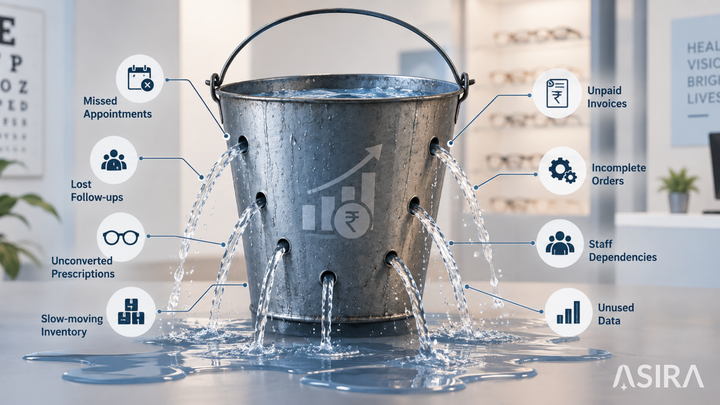
Patients want the personal attention of an independent practice combined with the convenience and efficiency of a large organisation. Many independent clinics deliver outstanding clinical care but struggle with fragmented workflows, paper records, disconnected software systems, manual recall processes, and limited access to operational analytics. This creates a competitive disadvantage that has nothing to do with clinical competence.
Why Technology Has Become the Great Equaliser
Historically, large organisations enjoyed substantial advantages because they could invest in sophisticated infrastructure. Today, cloud-based healthcare technology is changing that dynamic. Independent practices no longer need enterprise-sized budgets to access advanced operational tools. The challenge is finding solutions specifically designed for eye care rather than generic healthcare systems.nThis is where purpose-built platforms become important.
ASIRA was built around a simple belief: independent optometrists should have access to the same operational capabilities as large corporate organisations without sacrificing their independence. Built by eye care practitioners for eye care practitioners, ASIRA was designed specifically around the realities of optometric practice. Its purpose is not to make independent clinics behave like corporations. Its purpose is to remove the operational disadvantages that corporations exploit.
ASIRA supports independent practices through:
Enhanced Continuity of Care
- Automated recalls
- Follow-up reminders
- Comprehensive patient timelines
- Condition-specific monitoring workflows
These tools strengthen the continuity that patients already value while reducing administrative burden.
Improved Patient Experience
- Digital records
- Electronic prescriptions
- Integrated imaging
- Faster access to clinical information
- Streamlined appointment workflows
These capabilities allow practitioners to spend less time managing systems and more time caring for patients.
Multi-Branch Coordination
As independent practices grow, maintaining continuity becomes increasingly challenging. ASIRA enables secure access to records, appointments, billing, inventory, and communication across multiple locations, ensuring that growth does not compromise patient experience.
Data-Driven Practice Management
Corporate organisations rely heavily on analytics. Independent practices should have access to the same insights.
ASIRA provides visibility into:
- Recall compliance
- Patient retention
- Revenue trends
- Inventory performance
- Clinical workflows
These insights support evidence-based decision-making while preserving practitioner autonomy.
Conclusion
The future of optometry is not a battle between independent practices and corporate organisations. It is a question of how independent practices can preserve their unique strengths while adapting to evolving patient expectations. The evidence is clear. Patients continue to value trust, continuity of care, personalised communication, and long-term relationships. These are precisely the qualities that independent optometrists have delivered for generations. The challenge is no longer clinical excellence. The challenge is operational excellence. Independent practices already possess what patients value most. Platforms such as ASIRA help ensure they also possess the tools required to compete, grow, and thrive in an increasingly complex healthcare environment. The future of eye care should not be determined by who has the largest advertising budget. It should be determined by who delivers the best patient care. Independent optometrists are uniquely positioned to do exactly that.
References
- Review of Optometric Business. Industry Numbers Explore Economics and Patient Care. 2025.
- Future Market Insights. Vision Care Market Analysis 2025–2035.
- Chen EM, Cox JT, Begaj T, Armstrong GW, Khurana RN. Private Equity in Ophthalmology and Optometry: Analysis of Acquisitions from 2012–2019. Ophthalmology. 2020.
- Patil SA, et al. Private Equity in Ophthalmology and Optometry: A Time Series Analysis. Clin Ophthalmol. 2023.
- Physician Growth Partners. State of Eye Care Private Equity White Paper. 2025.
- Bain & Company. The Future of Independent Optometry.
- Burch P, et al. Patient Reported Measures of Continuity of Care and Health Outcomes. BMC Family Practice. 2024.
- Chan KS, et al. Effects of Continuity of Care on Health Outcomes. BMC Family Practice. 2021.
- Adler R, et al. The Relationship Between Continuity and Patient Satisfaction: A Systematic Review. Family Practice. 2010.
- Saultz JW, Albedaiwi W. Interpersonal Continuity of Care and Patient Satisfaction. Ann Fam Med. 2004.
- Alsaad SM, et al. The Relationship Between Continuity of Care and Patient Outcomes. 2024.
- van Walraven C, et al. The Association Between Continuity of Care and Outcomes. J Eval Clin Pract. 2010.
ASIRA is a simple and secure, cloud-based software tool, that helps eye care professionals reduce the time and effort required to maintain clinical records, schedule appointments, generate bills, manage inventory and much more!
To find out more, visit www.asira.health and sign up for a FREE TRIAL!

Comments ()