

Why "Off-Label" Is One of the Most Misunderstood Terms in Clinical Practice
Off-label doesn't mean unsafe or inappropriate. Learn what it really means and why orthokeratology is the perfect example.
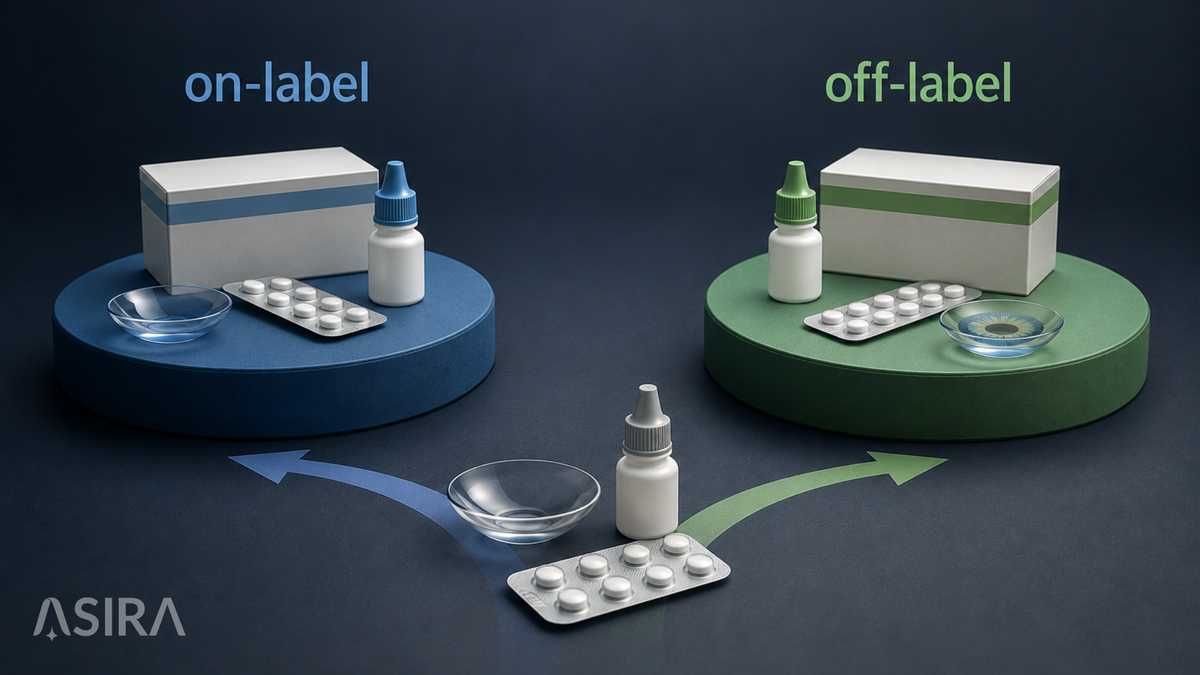
Mention the term off-label during a discussion with a group of eye care practitioners and you'll almost certainly get a range of reactions. Some associate it with increased medico-legal risk, others assume it refers to experimental treatments, while many simply avoid using products outside their labelled indication altogether. Despite how frequently the term is used, it remains one of the most misunderstood concepts in clinical practice.
The reality is that off-label use is neither unusual nor inherently inappropriate. Across healthcare, clinicians make evidence-based decisions every day that extend beyond the precise wording of a product's regulatory approval. In many cases, these decisions represent current best practice, supported by years of scientific evidence, even though the product label has not yet caught up.
Orthokeratology provides an excellent example of why understanding off-label use is so important for today's optometrist.
What does "off-label" actually mean?
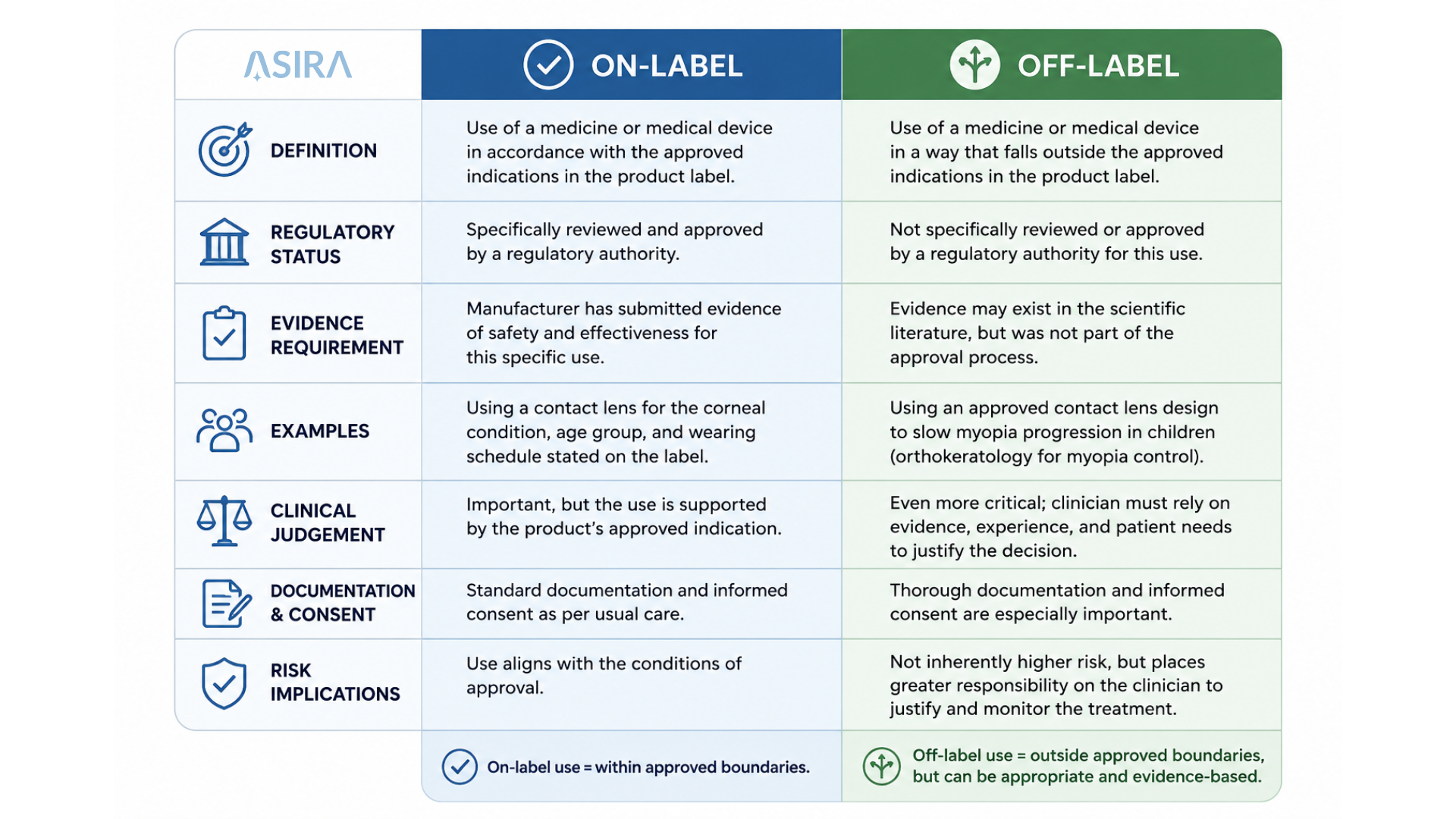
Every medicine and medical device is approved by a regulatory authority for specific indications. During the approval process, manufacturers submit evidence demonstrating the product's safety and effectiveness for a defined purpose, in a particular patient population and according to specified instructions for use. These details form the product's approved label.
When a clinician uses that product in a way that falls outside those approved indications, it is considered off-label. This may involve using it for a different condition, in a different age group, using an alternative treatment protocol, or for a purpose that is not specifically described in the regulatory approval.
The important point is that off-label is a regulatory term, not a judgement about clinical quality. It does not imply that a treatment is unsafe, ineffective or inappropriate. It simply means that the particular use has not been included within the manufacturer's approved labelling.
Why off-label use is so common
Many practitioners are surprised to learn just how frequently off-label use occurs throughout healthcare. In medicine, paediatrics, oncology, ophthalmology and optometry, clinicians regularly rely on published evidence and professional judgement to guide treatment decisions that extend beyond a product's original approval.
One reason for this is that scientific evidence often develops much faster than regulatory approvals. Conducting clinical trials, compiling regulatory submissions and obtaining approval for new indications is a lengthy and expensive process. By the time a manufacturer updates its product label, clinicians may already have years of high-quality evidence demonstrating additional clinical benefits.
As a result, regulatory approvals often represent the minimum evidence required for market authorisation rather than the full extent of current scientific knowledge. This is why evidence-based practice requires clinicians to consider more than simply the wording on a product label.
Orthokeratology: a practical example
Orthokeratology has traditionally been approved as a method of temporarily correcting myopia through overnight corneal reshaping. Patients wear specially designed rigid gas permeable lenses while sleeping, allowing them to enjoy clear unaided vision throughout the day.
Over the past two decades, however, our understanding of orthokeratology has changed considerably. A growing body of high-quality research has consistently shown that orthokeratology can also slow axial elongation and reduce the progression of myopia in children. Today, it is recognised internationally as one of the most effective optical interventions for myopia management and is included in numerous clinical guidelines around the world.
Interestingly, the regulatory approval for many orthokeratology lenses has not necessarily evolved at the same pace. In several countries, the approved indication continues to focus primarily on temporary refractive correction rather than myopia control. Consequently, an optometrist fitting orthokeratology lenses specifically to slow myopia progression may technically be using the product off-label, despite practising in accordance with current evidence and accepted standards of care.
Nothing about the lens itself has changed. What has changed is our understanding of its clinical benefits. The evidence has moved forward, while the regulatory wording has, in some cases, remained largely unchanged.
Does off-label mean you shouldn't do it?
Not at all. Evidence-based practice has always involved balancing the best available research with clinical expertise and the individual needs of the patient. If robust scientific evidence supports a particular treatment and the clinician believes it represents the most appropriate option, off-label use may be entirely justified.
At the same time, off-label use does place greater responsibility on the practitioner. Rather than relying solely on the manufacturer's approved indication, the clinician must be able to explain why that treatment is appropriate for the specific patient sitting in front of them. The decision should be based on published evidence, sound clinical reasoning and careful consideration of the expected benefits and potential risks.
Documentation becomes even more important
Whenever a product is used off-label, clear clinical documentation becomes especially valuable. The patient record should demonstrate the reasoning behind the treatment decision, including the diagnosis, alternative management options that were considered, the discussion of benefits and potential risks, evidence of informed consent and the proposed follow-up plan.
Good documentation serves several purposes. It supports continuity of care, allows other practitioners to understand the clinical reasoning and provides evidence that the decision was thoughtful, patient-centred and grounded in current scientific knowledge. Documentation should never be viewed simply as protection against complaints; it is an essential part of delivering high-quality clinical care.
Talking to patients about off-label use
Interestingly, most patients never ask whether a treatment is off-label. Instead, they ask whether it is the best option for them or for their child.
This means the conversation should focus less on regulatory terminology and more on explaining the available evidence in language that patients can understand. For example, when discussing orthokeratology for myopia management, it is reasonable to explain that although some lenses were originally approved to provide temporary vision correction, extensive research has demonstrated that they can also help slow the progression of myopia in suitable children. Framing the discussion around the evidence rather than the label helps patients make informed decisions without causing unnecessary concern.
Off-label is not the same as experimental
Perhaps the greatest misconception is that off-label use is synonymous with experimental treatment. These concepts are fundamentally different.
Experimental treatments are still being evaluated and often have limited evidence supporting their effectiveness. Off-label treatments, on the other hand, may be supported by decades of clinical experience, multiple randomised controlled trials, systematic reviews and widespread adoption within professional practice.
Orthokeratology for myopia management perfectly illustrates this distinction. Although regulatory approvals differ between manufacturers and countries, the scientific evidence supporting its role in slowing myopia progression is extensive. The treatment itself is well established, even if the regulatory language has not always kept pace with the evolving science.
Professional judgement remains central
Regulatory approvals provide an essential framework for ensuring that medical products reach the market safely. They are not, however, designed to dictate every future clinical application of those products. Healthcare continues to evolve long after a product receives approval, and it is the responsibility of clinicians to remain current with emerging evidence and incorporate it appropriately into patient care.
For optometrists, this means critically evaluating new research, understanding professional guidelines, selecting appropriate patients and communicating treatment decisions transparently. Off-label use should never be driven by convenience or anecdote, but neither should it be dismissed simply because the product label has not yet been updated.
The bottom line
The phrase off-label often sounds more alarming than it really is. In reality, it describes a regulatory classification rather than a measure of clinical quality. It does not automatically mean that a treatment is unsafe, inappropriate or outside accepted standards of care.
Orthokeratology demonstrates this perfectly. While many practitioners now use it primarily as a myopia management intervention, its regulatory approval in some regions continues to emphasise temporary refractive correction. The science has advanced more quickly than the labelling.
Ultimately, patients benefit most when clinicians understand both the regulatory framework and the scientific evidence. Good clinical care is not defined solely by what appears on a product label, but by the thoughtful application of evidence, sound professional judgement, informed consent and careful follow-up. Those principles, rather than the words on-label or off-label, remain the true foundation of evidence-based optometric practice.
ASIRA is a cloud-based EMR and practice management software built by eye care professionals for eye care professionals. We have helped hundreds of practices change the way they work. To find out more, visit www.asira.health and sign up for a FREE TRIAL!



Comments ()