

Why Optometry Regulation Differs Around the World And Why India’s NCAHP Act Matters
Optometry is one of the most diverse healthcare professions in the world. This variation is not simply a matter of clinical capability. It is shaped by legislation, regulation, education standards, healthcare infrastructure, and professional recognition.

Optometry is one of the most diverse healthcare professions in the world. In some countries, optometrists are fully integrated primary eye care providers who diagnose disease, prescribe medication, manage ocular conditions, and work alongside ophthalmologists within structured healthcare systems. In others, their role remains largely limited to refraction and dispensing spectacles.
This variation is not simply a matter of clinical capability. It is shaped by legislation, regulation, education standards, healthcare infrastructure, and professional recognition.
A recent global survey published in Clinical Optometry highlighted just how wide these differences are between countries. The study examined regulation, education, scope of practice, and workforce distribution across 39 countries affiliated with the World Council of Optometry (WCO).
The findings revealed a profession that is rapidly evolving globally, but also one that remains fragmented in terms of regulation and standardisation.
For India, this conversation is especially important.
For decades, Indian optometry has produced highly skilled clinicians and educators, yet the profession itself has existed in a regulatory grey area. The National Commission for Allied and Healthcare Professions (NCAHP) Act, introduced in 2021, represents one of the most important turning points in the history of Indian optometry because it lays the foundation for formal recognition, accountability, competency-based practice, and standardisation.
But regulation alone is not enough.
If India is to truly move toward global standards in eye care, practitioners also need systems, workflows, and clinical tools that support modern evidence-based practice. This is where digital platforms like ASIRA become increasingly important.
A Profession Defined Differently Around the World
The WCO global survey demonstrated that optometry is regulated very differently depending on geography and economic development.
In countries such as the United Kingdom, United States, Canada, Australia, and New Zealand, optometrists often function as primary eye care providers with broad clinical responsibilities. Many of these countries also meet or exceed the commonly observed ratio of one optometrist per 10,000 population.
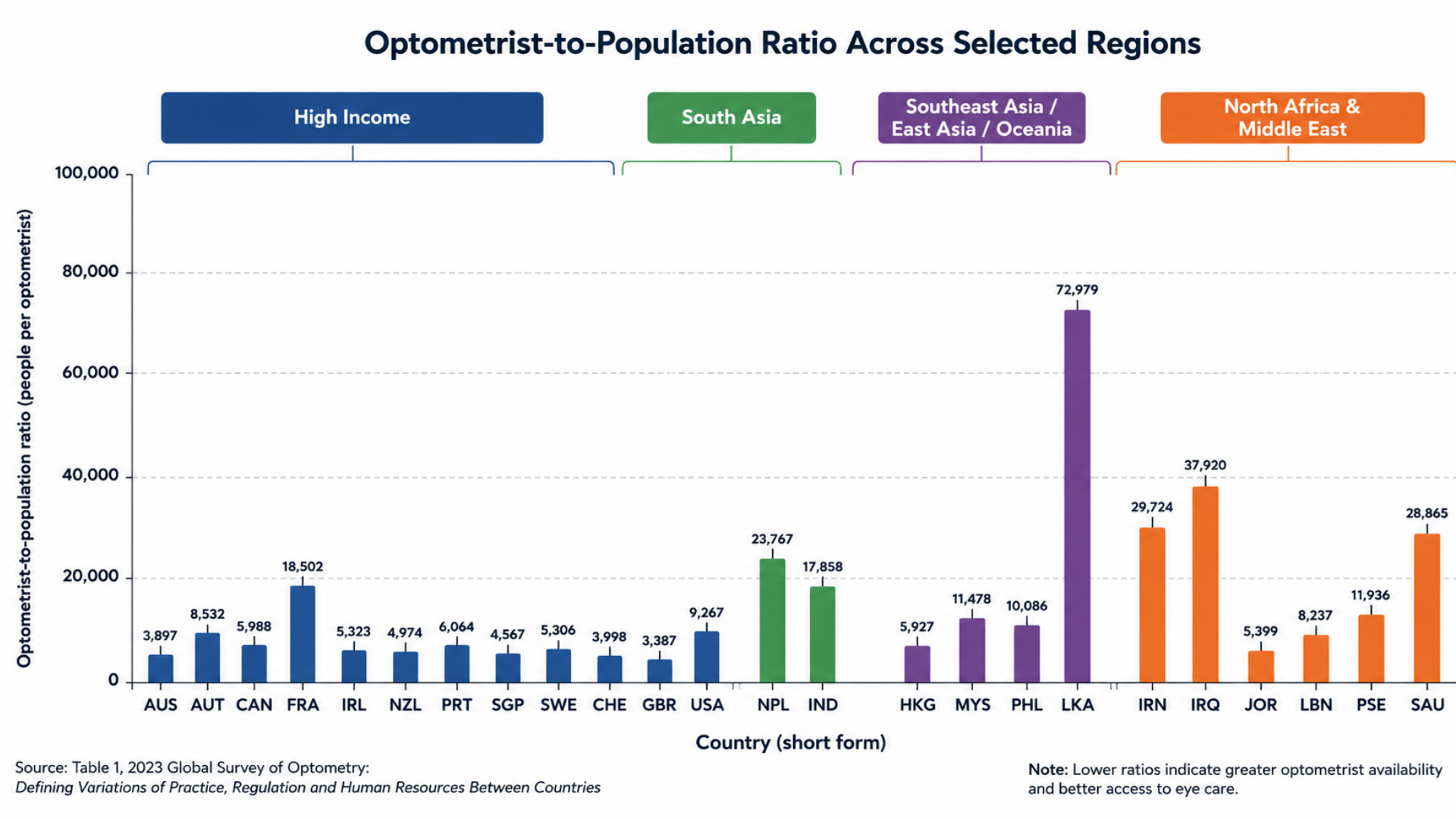
By contrast, many developing countries face major shortages of trained personnel, inconsistent educational pathways, and limited legal recognition of the profession.
The study found that:
- Only 46% of surveyed countries achieved the 1:10,000 optometrist-to-population ratio commonly seen in developed nations.
- One optometrist serves approximately 23,200 people on average globally.
- Several countries still do not legally regulate optometry as a profession.
- Many countries continue to restrict important clinical procedures such as diagnostic drugs, ocular disease management, and therapeutic prescribing.
The report specifically identified India as one of the countries where optometry was not formally regulated at the time of the survey.
This lack of regulation has historically created several challenges.
Without clear national standards, educational quality can vary significantly. Scope of practice becomes inconsistent between practitioners. Titles may not be protected. Documentation standards become difficult to enforce. Continuing education may not be mandatory. Most importantly, public understanding of what optometrists actually do becomes unclear.
The result is a profession with enormous potential, but without the unified structure necessary to fully realise it.
Why Regulation Matters
Healthcare professions cannot grow sustainably without regulation.
Regulation protects patients by defining who is qualified to practice, what competencies are required, and how accountability is maintained. It also protects practitioners by establishing legitimacy, professional recognition, and structured career pathways.
The WCO report highlighted how the absence of regulation can create inconsistencies in professional standards and scope of practice.
In countries where titles are not legally protected, individuals without adequate training may still use the title “optometrist.” This creates confusion for patients and undermines trust in the profession.
Similarly, countries without standardised educational requirements risk producing large variations in clinical competency.
Globally, there is also increasing recognition that optometrists must play a larger role in primary eye care. The burden of myopia, diabetic retinopathy, glaucoma, dry eye disease, and age-related vision problems continues to grow rapidly. The World Health Organization has repeatedly highlighted the importance of strengthening the eye care workforce to meet this demand.
Modern optometry is no longer limited to refractive care alone.
Today’s optometrist may be expected to:
- Detect ocular pathology
- Co-manage chronic eye disease
- Conduct myopia management
- Use diagnostic drugs
- Interpret imaging
- Manage binocular vision disorders
- Maintain detailed medico-legal documentation
- Coordinate care with other healthcare professionals
This requires not just knowledge, but systems that support safe and defensible practice.
The Significance of India’s NCAHP Act
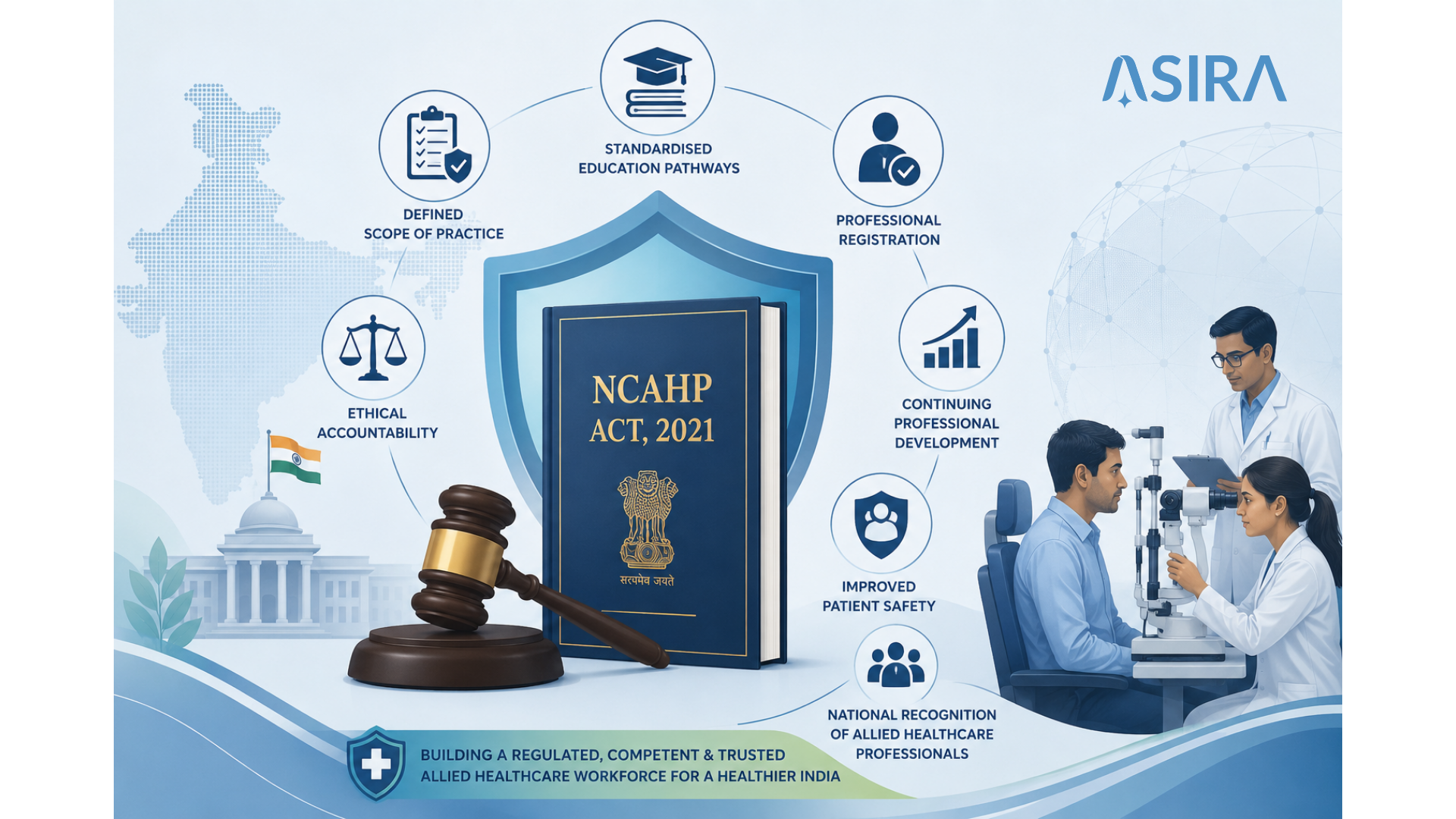
The National Commission for Allied and Healthcare Professions (NCAHP) Act, passed in 2021, is one of the most important developments for Indian optometry in recent history.
For the first time, allied healthcare professions including optometry are being brought under a formal regulatory framework at the national level.
The importance of this cannot be overstated.
The NCAHP Act creates the foundation for:
- Standardised education pathways
- Defined scopes of practice
- Professional registration
- Ethical accountability
- Continuing professional development
- Improved patient safety
- National recognition of allied healthcare professionals
In many ways, India is now moving toward the same structured professional model seen in countries with more mature optometric systems.
This is essential because India faces an enormous eye care burden. The WCO study noted that India has approximately one optometrist for every 17,858 people, which remains below the ratios commonly observed in developed countries.
At the same time, India also has:
- A rapidly growing myopia population
- Increasing diabetes prevalence
- Large rural populations with limited access to eye care
- High demand for primary vision care services
A well-regulated optometric workforce is critical to addressing these challenges.
However, legislation is only the first step.
The next challenge is implementation.
Moving From Basic Refraction to Full Scope Practice
One of the most important ideas highlighted in the WCO Competency Framework is that optometry extends far beyond refraction alone.
The framework includes competencies across:
- Refractive error management
- Visual function assessment
- Ocular health assessment
- Public health
- Professional practice and documentation
This is highly relevant in India because many practitioners historically trained within systems that focused heavily on optics and refraction, while exposure to broader clinical management varied considerably.
As the profession evolves under the NCAHP framework, practitioners will increasingly need to:
- Practice evidence-based care
- Document findings comprehensively
- Follow standardised clinical protocols
- Demonstrate clinical reasoning
- Maintain continuity of care
- Participate in continuing education
- Work within defensible medico-legal frameworks
This transition cannot happen through regulation alone.
Clinicians need practical support tools that help bridge the gap between traditional workflows and modern full-scope practice.
Why Digital Clinical Systems Matter
One of the biggest challenges in healthcare regulation is consistency.
Even highly trained clinicians can struggle when systems are fragmented, documentation is incomplete, or workflows are not standardised.
This is particularly important in eye care because documentation is not simply administrative. It is a clinical and medico-legal responsibility.
Accurate documentation helps:
- Improve patient safety
- Ensure continuity of care
- Track disease progression
- Support referrals and co-management
- Defend clinical decisions legally
- Maintain accountability standards
As regulation becomes more structured in India, expectations around documentation and clinical defensibility will naturally increase.
This is where digital systems like ASIRA become highly relevant.
How ASIRA Supports the Future of Indian Optometry
ASIRA was built specifically for eye care practitioners, which makes it uniquely positioned to support the evolution of optometric practice in India.
As practitioners transition toward practicing under a more formalised regulatory environment, ASIRA helps support:
- Structured clinical documentation
- Standardised examination workflows
- Comprehensive patient records
- Safer and more consistent clinical decision-making
- Better communication between practitioners
- Accountability and traceability
- Evidence-based practice patterns

Importantly, ASIRA also helps practitioners expand beyond limited or fragmented workflows into broader full-scope optometric care.
For students and junior optometrists especially, this can be transformative.
Many clinicians entering practice may understand theoretical concepts but still lack confidence in applying full-scope optometric decision-making consistently in real-world clinics. Tools that guide documentation, encourage comprehensive examinations, and reinforce clinical reasoning can accelerate professional development significantly.
As India aligns itself more closely with global standards through the NCAHP Act, practitioners will increasingly need systems that support modern standards of care rather than relying on paper records or inconsistent workflows.
In that sense, digital platforms are not merely administrative tools anymore.
They are becoming part of the infrastructure of modern healthcare regulation itself.
The Future of Indian Optometry
India has long had the clinical talent, educational institutions, and patient demand necessary to become a global leader in optometry.
What has historically been missing is unified structure and regulation.
The NCAHP Act changes that trajectory.
It represents a move toward:
- Professional recognition
- Defined competencies
- Greater accountability
- Stronger educational standards
- Safer patient care
- Better integration into healthcare systems
But the future of the profession will depend not only on legislation, but also on whether practitioners are equipped to meet these evolving expectations.
Countries with the strongest optometric systems do not simply have more optometrists. They have better infrastructure, stronger professional standards, broader scope of practice, and systems that support consistent care delivery.
India now has an opportunity to build exactly that.
The next phase of Indian optometry will belong to practitioners who embrace evidence-based care, structured clinical workflows, ongoing learning, and accountable documentation.
Regulation creates the framework.
Technology helps bring it to life.
And together, they have the potential to elevate Indian optometry to a truly global standard.
- Gammoh Y, Morjaria P, Block SS, Massie J, Hendicott P. 2023 Global Survey of Optometry: Defining Variations of Practice, Regulation and Human Resources Between Countries. Clinical Optometry. 2024;16:211–220.
- World Health Organization. World Report on Vision. Geneva: WHO; 2019. This report established the global need for integrated, people-centred eye care and highlighted workforce shortages as a major barrier to reducing avoidable vision impairment.
- World Health Organization. Eye Care Competency Framework. Geneva: WHO; 2022. This framework outlines the competencies required across eye care professions and supports the move toward standardised, competency-based healthcare delivery.
- World Council of Optometry. WCO Competency Framework for Optometry. St. Louis, Missouri: World Council of Optometry; 2024. This framework defines modern optometric competencies across refractive care, ocular disease management, public health, and professional practice.
- Burton MJ, Ramke J, Marques AP, et al. The Lancet Global Health Commission on Global Eye Health: Vision Beyond 2020. Lancet Global Health. 2021;9(4):e489–e551. This landmark report emphasises the importance of strengthening the eye care workforce to meet growing global demand.
- Naidoo KS, Govender-Poonsamy P, Morjaria P, et al. Global Mapping of Optometry Workforce. African Vision and Eye Health. 2023;82(1):a850. This study provides important data on workforce distribution and access to optometric care globally.
- World Health Organization. SPECS 2030 Initiative. WHO; 2024. The initiative focuses on ensuring universal access to quality refractive error services and strengthening eye care systems globally.
- Government of India. The National Commission for Allied and Healthcare Professions Act, 2021 (NCAHP Act). Ministry of Law and Justice, Government of India. This legislation established a regulatory framework for allied healthcare professions, including optometry, with the goal of standardising education, professional registration, and practice standards.
- Vashist P, Senjam SS, Gupta V, et al. Blindness and Visual Impairment and Their Causes in India: Results of a Nationally Representative Survey. PLOS One. 2022;17(7):e0271736. This study highlights the significant burden of visual impairment in India and the need for a stronger eye care workforce.
- Holden B, Resnikoff S. The Role of Optometry in Vision 2020. Community Eye Health Journal. 2002;15:33–36. This paper discusses the expanding role of optometrists in addressing global avoidable blindness and vision impairment.
- World Health Organization. Vision 2020: The Right to Sight - Global Initiative for the Elimination of Avoidable Blindness. Geneva: WHO; 2007. This initiative helped establish the global importance of developing sustainable eye care workforces.
- Woo GC, Woo SY. The Need for Full Scope Primary Eye Care in Every Country. Clinical and Experimental Optometry. 2013;96(1):1–3. This article argues for broader scope optometric practice to improve access to primary eye care services worldwide.
ASIRA is a simple and secure, cloud-based software tool, that helps eye care professionals reduce the time and effort required to maintain clinical records, schedule appointments, generate bills, manage inventory and much more!
To find out more, visit www.asira.health and sign up for a FREE TRIAL!



Comments ()