

What Your Practice Data Is Really Telling You
Every day, we make hundreds of decisions in our practices guided by years of clinical experience. However, some of the most valuable insights into our practice emerge only when we step back and look at the bigger picture.

Every day, we make hundreds of decisions in our practices. Some are guided by years of clinical experience, while others rely on evidence, protocols and the unique needs of the patient sitting in front of us. Every consultation requires us to interpret information, recognise patterns and make decisions that influence a patient's eye health.
However, some of the most valuable insights into our practice don't come from a single consultation. They emerge only when we step back and look at the bigger picture.
Every appointment booked, every clinical finding recorded, every follow-up scheduled and every order placed contributes to a much larger story. Collectively, this information tells us how our practice is functioning, where patients may be slipping through the cracks and where opportunities exist to improve both patient care and practice performance.
The challenge isn't collecting more data. It's learning to ask better questions of the information we already have.
A full diary doesn't always mean a healthy practice
A fully booked appointment book is often seen as a sign of success, but appointments booked are only the beginning of the story. What really matters is what happens next.
How many patients actually attend? How many cancel? How many fail to arrive? Are certain appointment types more likely to result in no-shows? Do longer booking intervals lead to poorer attendance?
These are more than administrative questions. They have direct clinical implications. A missed routine eye examination may be inconvenient, but a missed glaucoma review, diabetic eye examination or myopia management appointment could delay treatment and affect long-term outcomes.
Research has shown that no-show rates increase as booking lead times become longer, while factors such as age, appointment time and previous attendance behaviour can also influence whether patients attend. Understanding these patterns allows practices to introduce targeted reminders, improve recall systems and reduce missed appointments before they become a clinical problem.
Growth isn't just about attracting new patients
Many practices measure success by the number of new patients they see. While attracting new patients is important, it only tells part of the story.
The more meaningful question is whether patients choose to return.
Optometry is built on long-term relationships. Patients return for routine eye examinations, contact lens reviews, myopia management, dry eye care and chronic disease monitoring over many years. Every returning patient is a reflection of the trust they have placed in your practice.
Practice data can help identify which referral sources generate loyal patients, which services encourage long-term engagement and where patients are quietly dropping out of care. Often, improving communication and the overall patient experience has a greater impact on retention than increasing marketing activity.
The patients you don't see matter just as much
Some of the greatest risks to patient care involve patients who never return.
A patient with early glaucoma, diabetic retinopathy or progressive myopia may be advised to return in six months, but unless practices actively monitor follow-up appointments, those patients can easily disappear from the care pathway.
This is where practice data becomes an important clinical safety net. Linking recommended review dates with appointments that are booked, attended and completed allows practices to identify overdue patients before they are lost to follow-up.
The Royal College of Ophthalmologists recommends monitoring follow-up timeliness because delays can compromise patient care. Digital practice management systems make this process significantly easier by highlighting overdue reviews and helping practices prioritise patients according to clinical risk.
Your patient population is constantly changing

Every patient contributes to a larger picture of the eye health needs within your community. Looking at these trends over time allows practices to move beyond clinical intuition and make evidence-informed decisions.
You may discover that the prevalence of dry eye disease has steadily increased over recent years, or that more children are presenting with progressive myopia. Perhaps referrals for cataract surgery are becoming more common, or diabetic eye disease is increasing within a particular age group.
These observations help shape the future of your practice. They can guide investment in new services, staff training, equipment and patient education. Local practice data doesn't replace published research, but it tells you how those broader trends are affecting the patients you see every day.
Looking beyond the consultation
Clinical care doesn't end when the examination is complete.
The journey continues through investigations, optical dispensing, contact lens orders, follow-up appointments and ongoing communication. Looking at each stage of this pathway can reveal opportunities to improve both efficiency and the patient experience.
For example, are patients accepting your recommendations but delaying purchases? Are certain products associated with repeated remakes? Are there delays between ordering and collection? These insights help practices identify where workflows can be improved without compromising patient-centred care.
Similarly, reviewing tasks across the practice often reveals hidden inefficiencies. Recurring administrative tasks, delayed follow-up calls or outstanding investigation reviews may highlight opportunities to introduce standardised workflows, templates or automation, allowing the team to spend more time focusing on patients rather than repetitive administration.
Turning information into better patient care
Modern practice management systems collect an enormous amount of information every day. The real value lies not in recording more data, but in understanding what that data is telling us.
When appointments, clinical records, follow-ups, inventory and billing are connected within a single system, patterns begin to emerge that would otherwise remain hidden. Rather than looking at isolated numbers, practices gain a clearer understanding of the complete patient journey.
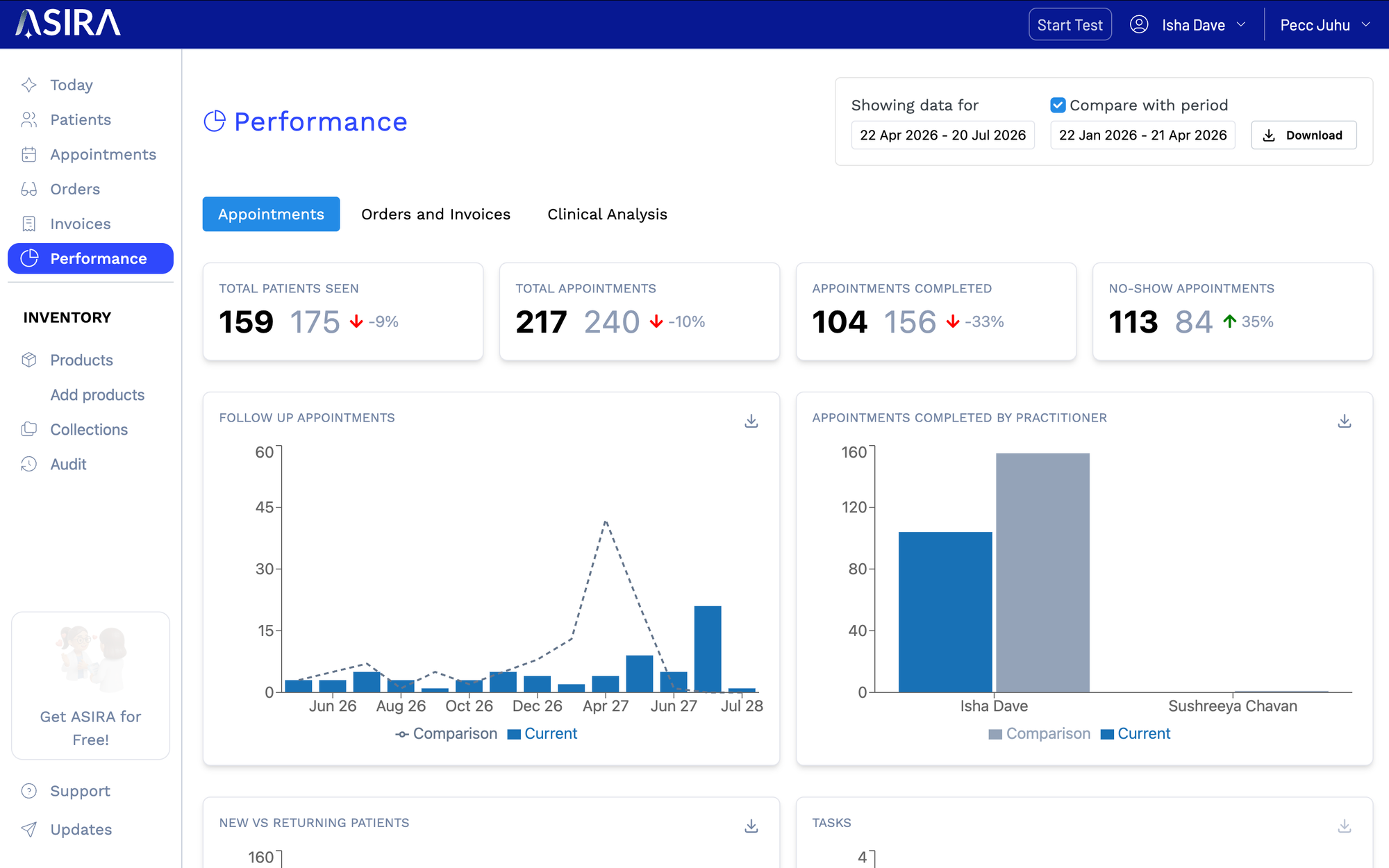
Within ASIRA, this philosophy has shaped the development of every feature. Structured clinical templates, integrated appointment management, inventory, billing and performance dashboards are designed not simply to digitise records, but to help practitioners better understand their practice and make more informed decisions.
Technology should never replace clinical judgement. Instead, it should support it.
Ultimately, practice data isn't about producing more reports or monitoring more graphs. It's about recognising opportunities to improve communication, strengthen continuity of care, refine workflows and deliver better outcomes for every patient.
At its heart, every successful practice is built on good clinical judgement, strong relationships and trust. Used thoughtfully, practice data strengthens each of these, helping us become not only better practice owners, but better clinicians.
ASIRA is a cloud-based EMR and practice management software built by eye care professionals for eye care professionals. We have helped hundreds of practices change the way they work. To find out more, visit www.asira.health and sign up for a FREE TRIAL!



Comments ()