

Myopia management 2.0: Updated graphs, extended patient history and forecasting tools.
The International Myopia Institute describes ongoing monitoring of refraction and axial length as central to comprehensive myopia management. ASIRA’s updated Myopia Management Template is designed around this approach
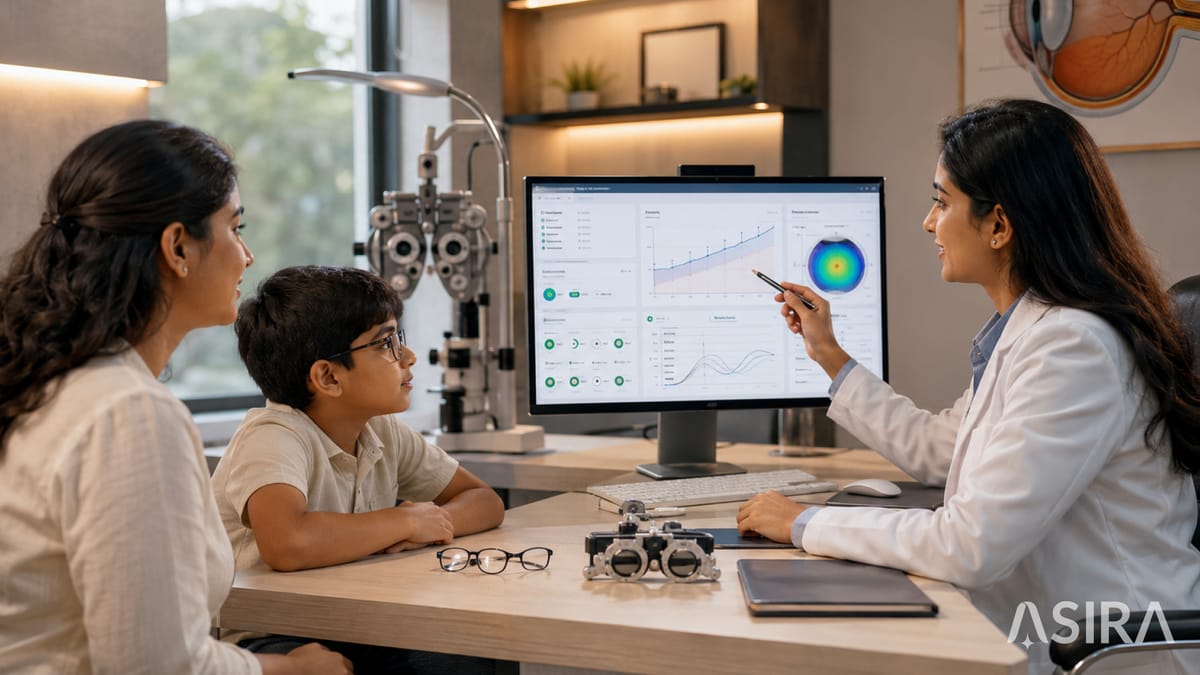
Myopia management has moved far beyond correcting blurred distance vision, using early detection, appropriate refraction, risk assessment, axial length monitoring, lifestyle counselling, targeted intervention and regular review these days. The International Myopia Institute describes ongoing monitoring of refraction and axial length as central to comprehensive myopia management. The World Health Organization also recognises that increased outdoor time and reduced intensive near work may help delay myopia onset and slow progression. India’s national consensus guidelines for childhood progressive myopia similarly call for structured refraction, clinical work-up, treatment planning and follow-up.
ASIRA’s updated Myopia Management Template is designed around this approach with the aim of helping practitioners connect previous visits, current findings, progression risk, forecasting and patient communication in a single clinical workflow.
How the original template evolved.
The earliest version introduced axial length within the measurements workflow. Subsequent updates added myopia-specific lifestyle history, including outdoor exposure and near work, along with separate maternal and paternal ocular histories.
The previous risk assessor then brought these records together for children up to 10 years of age. It used age, parental myopia, axial length and spherical refractive error to calculate separate O.D and O.S scores. The result was presented as a colour-coded risk of myopia development, accompanied by a predicted refractive outcome.This gave clinicians a useful single-visit assessment.
The latest update builds on that foundation by introducing a broader progression-risk framework, longitudinal calculations and visual forecasting.
Refraction history helps reveal changes earlier.
A major addition begins with the Objective-Subjective Refraction workflow where practitioners can now view the patient-history data as line graphs for:
- Distance sphere
- Distance cylinder
- Cylinder axis
A zero dioptre reference line provides additional visual context for sphere and cylinder. Tooltips show the recorded value at each visit, while separate lines make inter-eye differences easier to follow.
This turns a series of old prescriptions into a readable clinical timeline. A practitioner can see whether the sphere is moving in a more minus direction, whether astigmatism is changing or whether one eye is progressing differently from the other.
While the graph does not diagnose myopia or determine onset automatically, it gives the practitioner a clearer longitudinal signal. A developing minus trend can help identify possible myopia onset earlier and prompt cycloplegic refraction, axial length measurement or a more comprehensive myopia evaluation where clinically indicated.
At the practice level, ASIRA’s associated refractive-error performance chart provides a different view. It summarises monthly patient counts across myopia, high myopia, hypermetropia, astigmatism and presbyopia. Practices can also compare totals between selected reporting periods. This population level view helps teams understand changes in their refractive patient mix, while the patient-level history graphs support individual clinical review.
How progressions are calculated.
The updated myopia workflow can retrieve valid Subjective Refraction and axial-length measurements from completed earlier appointments. It compares the latest available prior measurement with the current result and annualises the difference to calculate:
- Spherical-equivalent change in dioptres per year
- Axial-length change in millimetres per year
- Separate progression values for each eye
- The elapsed time between the two measurements
For the current visit, cycloplegic refraction is prioritised when available. If it has not been recorded, the assessor uses the available subjective refraction. Practitioners may also enter annual progression values manually when a clinically appropriate measurement has come from another source.
When no previous value exists, the system clearly identifies the current measurement as a baseline rather than presenting an invented historical comparison.
A broader, transparent progression-risk assessment
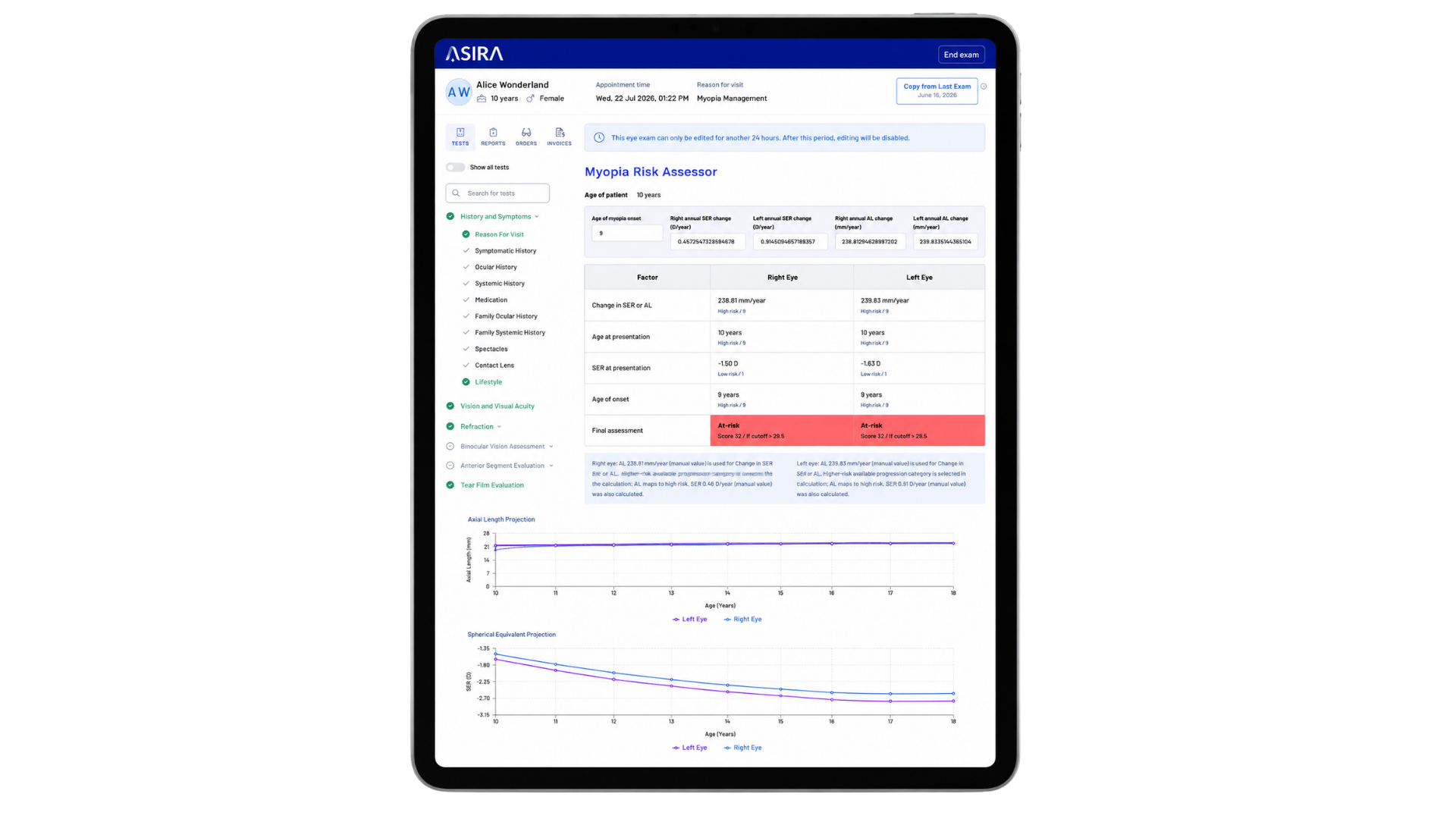
The current risk assessor evaluates progression through a tiered, multi-factor calculation. The updated clinical workflow now assess a wider view of records to include near-work exposure, near esophoria, accommodative lag and parental myopia, giving practitioners additional context for interpretation and counselling.
Each available factor is grouped into a low, intermediate or high-risk band. When both refractive and axial-length progression are available, the system uses the measurement associated with the higher progression-risk category and records why that source was selected.
The assessor then applies the most complete calculation tier supported by the available data. It presents a score, the applicable threshold and an eye-specific result of risk level - low, medium or high. If the minimum required information is missing, it reports the assessment as incomplete instead of treating missing data as a normal finding.
This assessment is meant to simplify clinical decision support BUT DOES NOT REPLACE practitioner judgement or independently prescribe treatment. Practitioners are expected to verify and cross-check the results of the final assessment.
Forecasting axial length and spherical equivalent
The new template includes two forecasting graphs.
When current axial length and spherical equivalent are available, ASIRA plots projected axial-length trajectories for both eyes from the patient’s current age through age 18.
For a patient with a myopic baseline refraction, it also plots projected spherical-equivalent trajectories over the same period.
These charts can make discussions with parents easier. Instead of presenting isolated numbers, practitioners can use a visual trajectory to explain why monitoring, lifestyle changes and treatment adherence matter.
The distinction is important: the Objective and Subjective test displays recorded historical power values, while the risk assessor displays future estimates. Forecasts depend on the accuracy and completeness of the underlying data and should not be presented as guaranteed outcomes.
More informative reports and discharge summaries.
The Action and Advice brings together further tests or referrals, urgency, spectacle recommendations, follow-up, suggested advice, the selected myopia management strategy and medication where recorded.
The discharge summary now carries more of the clinical reasoning. Maternal and paternal ocular histories can be presented separately. The risk section communicates progression status, the applied threshold and the rationale behind the chosen progression measurement.
The Ultimate Goal: better continuity for practitioners and patients.
For practitioners, the updated template reduces repeated data entry, annualises progression consistently and makes the source of each assessment easier to verify. Graphs help reveal emerging changes, while forecasting tools support clearer counselling.
For patients and parents, the result is a more understandable journey: where the eyes have been, what the current measurements show, how progression risk has been assessed and what should happen next.
That is the real shift in Myopia Management 2.0: from recording a prescription to having a deeper understanding of change over time.
ASIRA is a cloud-based EMR and practice management software built by eye care professionals for eye care professionals. We have helped hundreds of practices change the way they work. To find out more, visit www.asira.health and sign up for a FREE TRIAL!


Comments ()