

Occupational Lenses and How to Match Lens Design to Working Distance and Visual Demands
Discover how occupational lenses support different working distances and visual demands. Learn about office lenses, degressive designs and occupational progressives.
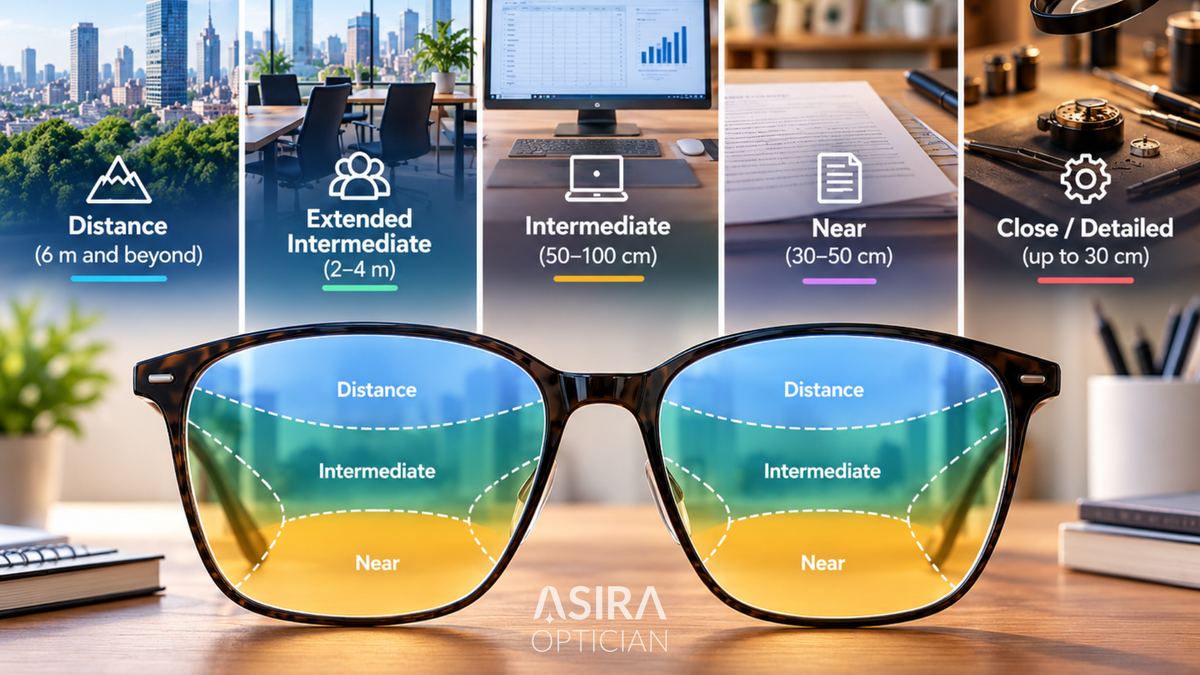
Not every customer needs spectacles designed primarily for distance or everyday use. A person who spends eight hours working at a computer, a dentist examining patients at close range, an architect switching between a monitor and drawings, and a mechanic working beneath a vehicle all have different visual requirements. Yet these customers may all arrive at an optical store asking for a pair of glasses that will help them work comfortably.
This is where occupational lenses can make a real difference.
For optometrists and optical dispensing professionals, understanding occupational lens designs is an important part of providing individualised eyewear solutions. The aim is to match the lens to the customer's working distances, visual tasks and posture, rather than simply recommending a lens based on their prescription.
What are occupational lenses?
Occupational lenses are designed to support specific visual activities, particularly when the demands of work differ from those of general distance and near vision. They are often used by people who spend extended periods working at intermediate and near distances.
Unlike conventional single-vision reading lenses, which primarily support a defined near working distance, or general-purpose progressive addition lenses, which are designed to provide distance, intermediate and near vision within one lens, occupational designs can prioritise the visual zones most relevant to a person's work.
Depending on the design, an occupational lens may provide a wider intermediate zone, a more generous near zone, or a combination of both. Some designs also offer limited distance vision, although the available range varies considerably between lens types.
Occupational lenses are particularly relevant for presbyopic patients, but they may also be useful for other individuals whose visual requirements are not adequately met by their everyday spectacles.
Why working distance matters
One of the most important considerations when selecting an occupational lens is the distance at which a customer performs their usual tasks.
Different activities require different accommodative demands and visual field positions. A lens that works well for reading a book may not be suitable for someone using a desktop monitor, and a lens designed for computer work may not provide sufficient range for someone who regularly moves between several work surfaces.
Consider three common working distances:
- Near vision: Reading documents, examining small objects, writing or performing detailed manual tasks.
- Intermediate vision: Using a desktop monitor, viewing a workstation or interacting with equipment positioned at arm's length.
- Extended intermediate vision: Viewing multiple monitors, interacting with colleagues across a desk or working in a larger workstation environment.
These distances are not fixed categories. A computer monitor might be positioned at 50 cm for one person and 80 cm for another. The appropriate lens design must account for the actual working environment.
For optometrists, this means asking customers about their work rather than relying on a generic description such as "computer use". For dispensing professionals, it means ensuring that the selected design and fitting parameters are appropriate for the intended task.
Understanding the main occupational lens designs
1. Single-vision occupational lenses
Single-vision lenses can be prescribed for a specific working distance. For example, a lens designed for a desktop computer may provide comfortable vision at the patient's usual monitor distance.
These lenses can be useful when the customer's primary task is performed within a relatively narrow range of distances. They can also offer a broad, uninterrupted viewing area for that particular distance.
However, a single-vision occupational lens does not automatically provide clear vision at all distances. A computer prescription may not be suitable for reading at a closer distance or for seeing clearly across a room.
This distinction is important when counselling patients. Occupational spectacles should not be presented as a universal replacement for their everyday distance or general-purpose spectacles.
2. Degressive or office lenses
Degressive lenses are designed to provide a broad intermediate and near viewing range, with lens power gradually changing to support different working distances. They are often referred to as office lenses, although the exact terminology and available designs vary between manufacturers.
These lenses can be particularly useful for presbyopic patients who need to alternate between a computer screen and closer tasks, such as reading documents or writing notes.
Compared with a conventional reading prescription, a suitable degressive design may allow the wearer to see clearly across a greater range of working distances. The amount of intermediate and near coverage depends on the lens design and its specified maximum viewing distance.
For example, a patient who alternates between a laptop positioned at 60 cm and documents positioned at 40 cm may benefit from a design that supports both distances without requiring frequent changes of spectacles.
3. Occupational progressive addition lenses
Occupational progressive lenses use a progressive change in power to support intermediate and near vision. Depending on the design, they may also provide some distance vision.
They are useful when a customer needs to move between different working distances rather than focus on a single task. However, occupational progressives are not all alike. Some prioritise near vision, while others provide a wider intermediate zone or extend the usable field to greater distances.
A critical part of dispensing is understanding the intended maximum viewing distance of the selected lens. Some office designs may allow useful vision across a room, while others are intended primarily for desk-based work.
Customers should understand these limitations before purchase, particularly if they expect to use one pair of spectacles for driving, walking outdoors and working at a computer.
Matching occupational lenses to different professions
The most appropriate occupational lens depends on what a person does, where their visual targets are positioned and how frequently they switch between them.
Office workers and computer users
Office workers commonly alternate between monitors, documents, mobile phones and colleagues. Their visual needs may involve several intermediate and near distances throughout the day.
For a presbyopic patient, an occupational progressive or degressive lens may offer a useful combination of intermediate and near vision. The choice depends on monitor position, desk layout, the need to read printed material and whether the person must frequently look across the room.
For customers who work with a single monitor at a consistent distance, a suitable single-vision computer prescription may also be appropriate.
Dentists and other healthcare professionals
Dentists, dental hygienists and some other healthcare professionals work at close distances while also needing to view instruments, screens and surrounding equipment.
Their requirements may involve sustained near vision, intermediate vision and specific head or neck positions. The appropriate solution must be based on the actual working posture and visual distances.
In these situations, lens selection should also account for any specialist requirements, such as magnification systems, protective eyewear and the positioning of loupes.
Designers, architects and engineers
These professionals may alternate between computer-aided design software, technical drawings, documents and colleagues. Their work can involve a wider range of distances than conventional desk-based tasks.
A lens with a generous intermediate zone may be useful, but the final choice should reflect the distance to the monitor, the position of drawings and the need to view the surrounding workspace.
Tradespeople and technicians
Electricians, mechanics, jewellers and technicians may work with small components at close range while also looking at tools, equipment or instructions positioned farther away.
Their visual demands can change significantly with posture and task. Some may benefit from a dedicated near or intermediate prescription, while others require a design that supports several working distances.
Safety is also an important consideration. Occupational spectacles must not compromise the use of appropriate protective eyewear or be mistaken for safety-rated glasses unless they meet the relevant requirements.
Teachers and professionals who interact with people
Teachers, trainers and professionals conducting face-to-face consultations often need to alternate between reading or writing and looking at people at a distance.
An occupational design may be helpful for some of these tasks, but the required range is particularly important. If the wearer needs clear vision across a classroom or meeting room, a design intended only for close desk work may be unsuitable.
The importance of taking an occupational history
Choosing an occupational lens should begin with understanding the customer's visual environment. A prescription alone cannot establish which design will be most suitable.
During the consultation, consider asking:
- What are your main tasks during a typical working day?
- How far away is your computer screen or primary work surface?
- Do you use one monitor or several?
- How often do you switch between a screen, printed documents and people?
- Do you need to see clearly across the room?
- Do you currently experience eyestrain, blurred vision, headaches or difficulty maintaining a comfortable posture?
- What spectacles do you currently use, and what limitations have you noticed?
- How many hours each day do you spend performing these tasks?
Where possible, obtain actual working-distance measurements rather than relying entirely on estimates. For more complex requirements, a photograph or simple description of the workstation may help clarify the visual environment.
The consultation should also establish whether symptoms may relate to an uncorrected refractive error, presbyopia, binocular vision difficulties, ocular surface problems or other factors that require clinical assessment. Occupational lenses are not a substitute for investigating persistent visual symptoms.
Fitting and dispensing considerations
Selecting the right lens design is only part of the process. Accurate fitting and clear communication are equally important.
Working distance and prescription
The prescription should support the intended working distance. A lens designed for one distance may not provide the required clarity at another, particularly when the wearer has presbyopia.
The optometrist should determine the appropriate prescription and consider relevant binocular vision and accommodative factors. The dispensing professional should ensure that the selected lens design is consistent with the prescribed requirements.
Frame selection and fitting measurements
Frame dimensions, fitting height, vertex distance, pantoscopic tilt and other fitting parameters can influence how the wearer accesses the useful areas of a lens.
A frame that is too small or poorly positioned may limit the available viewing area. Conversely, a well-selected frame can help the wearer access the intended intermediate and near zones comfortably.
Manufacturers' fitting requirements should be followed, particularly for progressive and other customised occupational designs.
Posture and ergonomics
Occupational lenses should support a comfortable working posture. A wearer who has to repeatedly lift their chin or tilt their head to see through the appropriate lens zone may not have a satisfactory solution.
It is important to assess how the spectacles interact with the person's usual posture and workstation. In some cases, adjusting the monitor height, screen distance or chair position may improve comfort alongside the optical correction.
Setting realistic expectations
Customers should understand what their occupational spectacles are designed to do and where their limitations lie.
Some people may benefit from maintaining separate pairs for distance, general use and work. Others may prefer a general-purpose progressive for everyday activities and a dedicated occupational pair for prolonged screen or near work.
The recommendation should reflect the customer's actual needs, not the assumption that one pair of spectacles must meet every visual requirement.
Occupational lenses and digital eye strain
Digital eye strain is a common concern among people who spend prolonged periods using computers and other digital devices. Symptoms can include tired eyes, discomfort, intermittent blurred vision and headaches.
Occupational lenses may help when visual discomfort is associated with an unsuitable refractive correction or difficulty accessing the required working distances. However, they should not be presented as a guaranteed solution to all symptoms of digital eye strain.
Other contributing factors may include reduced or incomplete blinking, dry eye, prolonged uninterrupted near work, glare, poor lighting, screen positioning and uncorrected visual problems.
A comprehensive assessment should consider these factors rather than assuming that a different lens design alone will resolve the problem. Practical advice on regular breaks, appropriate screen positioning and managing ocular surface symptoms may also be relevant.
The opportunity for optical stores
Occupational lenses offer optical stores an opportunity to move beyond routine spectacle dispensing and provide solutions tailored to customers' working lives.
Many customers do not realise that their everyday spectacles may not be the most appropriate option for prolonged computer use or specialised near tasks. By asking the right questions, optical professionals can identify unmet visual needs and explain the available options clearly.
This is not about recommending additional pairs unnecessarily. It is about identifying when a dedicated occupational solution offers a meaningful benefit and helping the customer understand the reasons behind the recommendation.
For optical store owners, developing staff knowledge in this area can also improve the quality and consistency of dispensing consultations. Staff should be able to recognise common occupational requirements, gather relevant information and know when a case requires assessment by an optometrist.
The right lens begins with understanding the task
Occupational lens dispensing is ultimately about matching optical design to real-world visual demands. The customer's prescription, working distances, posture, task variation and expectations all contribute to the decision.
For optometrists and dispensing professionals, the most useful starting point is not the question, "Which occupational lens should I recommend?" It is, "What does this person need to see, at what distances, and for how long each day?"
Answering that question makes it easier to select an appropriate design, establish realistic expectations and provide a more personalised dispensing experience.
For optical stores, that is the value of occupational lens expertise: better-informed recommendations, more thoughtful dispensing and eyewear solutions that reflect how people actually work.
Download the ASIRA Optician App TODAY and start your FREE TRIAL! www.asira.health/optician
Comments ()