

Can Clinical Templates Improve Diagnostic Accuracy?
Every optometrist develops their own routine. Over time, we learn which questions to ask first, which tests are essential, and how to adapt an examination based on the patient's symptoms.

Every optometrist develops their own routine. Over time, we learn which questions to ask first, which tests are essential, and how to adapt an examination based on the patient's symptoms. Experience shapes our clinical judgement, but even the most experienced practitioner is still human. We become busy, distracted, interrupted, or simply fall into familiar habits.
That is why aviation has checklists. It is why surgeons use surgical safety protocols. And it is why clinical guidelines exist across every healthcare profession.
Clinical templates are not designed to replace clinical reasoning. Instead, they provide a structured framework that helps ensure every patient receives a comprehensive, consistent assessment while allowing the practitioner to focus on making informed clinical decisions.
As eye care continues to evolve, the question is no longer whether digital records are beneficial. The more important question is whether structured clinical templates can improve diagnostic accuracy and ultimately lead to better patient outcomes.
Why consistency matters in clinical practice
No two patients present in exactly the same way. A patient attending for blurred vision may have a simple refractive error, early cataract, keratoconus, glaucoma or even neurological disease. The clinician's role is to gather enough relevant information to confidently distinguish between these possibilities.
Research has consistently shown that diagnostic accuracy improves when clinicians collect comprehensive and structured patient information. Missing clinical details can increase diagnostic uncertainty and contribute to variability between practitioners, particularly those with less clinical experience.
In optometry, this means ensuring that every examination includes not only visual acuity and refraction, but also an appropriate history, ocular health assessment, risk factor evaluation and documentation of clinical findings.
Without a structured approach, important information can easily be overlooked.
The challenge of relying on memory
Even experienced clinicians cannot remember every question, every grading scale or every examination sequence for every condition they encounter.
Consider a patient presenting with symptoms of dry eye. During a busy clinic, it is easy to remember to assess tear break-up time but forget to record meibomian gland function or document symptom severity using a validated questionnaire. Similarly, during a glaucoma review, a practitioner may carefully evaluate intraocular pressure and optic nerve appearance but omit documentation of family history, medication compliance or previous progression.
These omissions are rarely the result of poor clinical knowledge. More often, they are the consequence of cognitive overload. Clinical templates reduce that burden by acting as structured prompts throughout the examination.
Clinical templates support clinical thinking
One common misconception is that templates encourage "tick-box medicine." In reality, a well-designed template does the opposite. Rather than dictating a diagnosis, it prompts the clinician to collect all relevant information before making one. Clinical reasoning remains entirely in the hands of the practitioner.
The template simply asks:
- Have you documented the symptoms?
- Have you assessed the relevant risk factors?
- Have you examined each structure that should be evaluated?
- Have you recorded the findings consistently?
Only after those questions have been answered does diagnostic reasoning begin.
This distinction is important. Templates improve the quality of data collection. Clinicians provide the interpretation.
Better documentation leads to better diagnoses
Good documentation serves several purposes and improves communication between clinicians, supporting continuity of care as well as providing medico-legal protection. Most importantly, it allows subtle clinical changes to be identified over time.
Take keratoconus as an example. A patient may show only minor corneal changes during their first visit. Months later, comparison of previous findings may reveal progressive thinning or increasing irregular astigmatism. Without detailed, standardised records, those changes may be difficult to appreciate. The same principle applies to glaucoma, diabetic eye disease, dry eye disease and myopia management.
Consistency across visits is often just as valuable as accuracy during a single consultation.
Clinical variability is a recognised challenge
One of the biggest challenges in healthcare is reducing variation between clinicians. Two competent practitioners examining the same patient should ideally arrive at similar conclusions. Standardised examination pathways help achieve this by ensuring everyone collects similar information before reaching a diagnosis.
Recent research exploring diagnostic decision-making highlights how the completeness of clinical information directly influences diagnostic confidence and consistency, particularly among less experienced clinicians.
Templates do not eliminate differences in clinical judgement, but they reduce unnecessary variation caused by incomplete examinations.
The role of technology
Paper templates have existed for decades, but digital templates offer significant additional advantages.
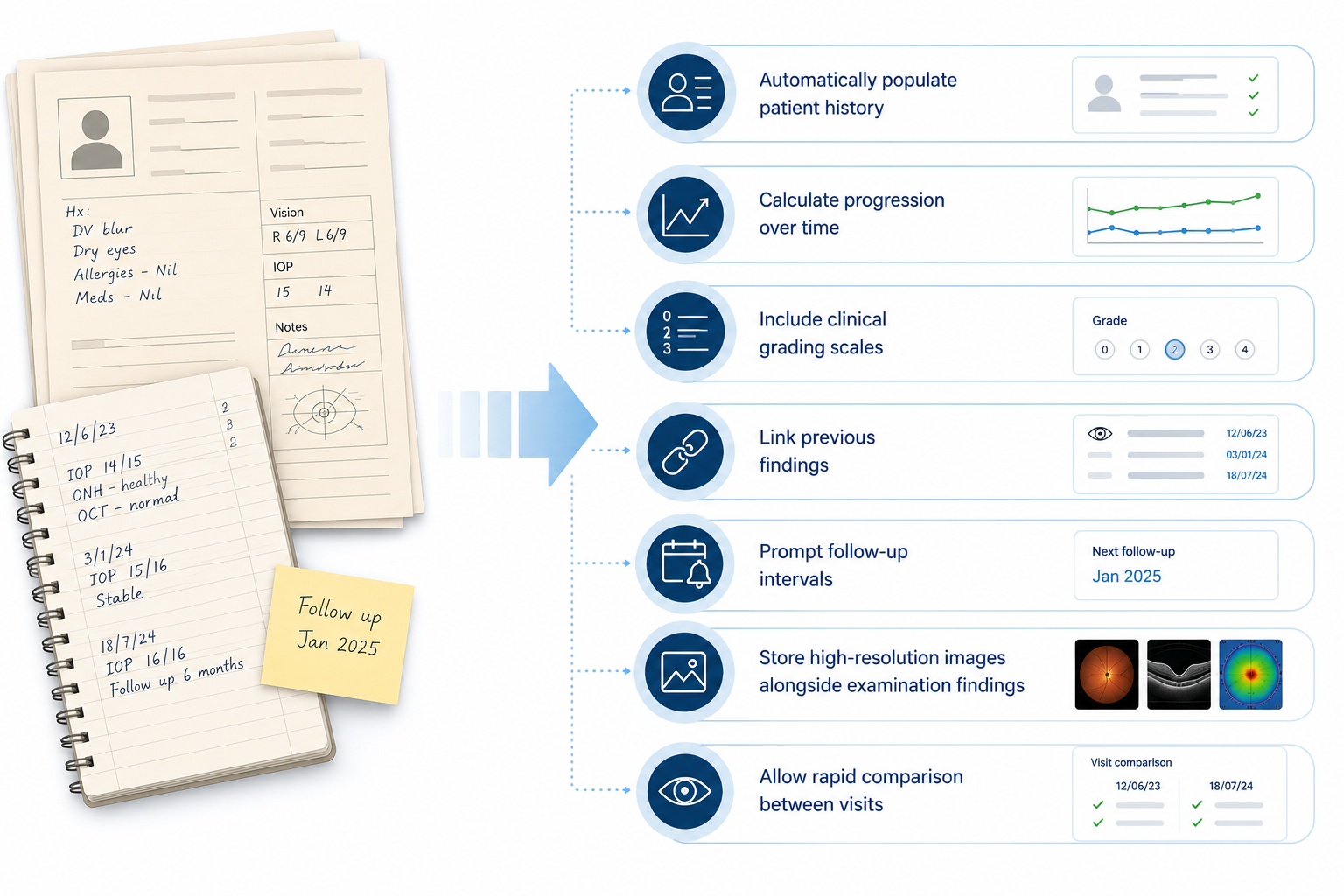
Unlike paper forms, electronic templates can:
- automatically populate patient history
- calculate progression over time
- include clinical grading scales
- link previous findings
- prompt follow-up intervals
- store high-resolution images alongside examination findings
- allow rapid comparison between visits
Instead of spending time searching through handwritten notes, clinicians have immediate access to structured information that supports faster and more confident decision-making.
How ASIRA supports structured clinical care
At ASIRA, clinical templates were designed by practising optometrists who understand the realities of a busy clinic. The goal was never to standardise practitioners, but to standardise the quality of documentation while preserving complete clinical flexibility.
ASIRA includes ready-to-use templates for common clinical scenarios including:
- comprehensive eye examinations
- contact lens assessments
- dry eye evaluations
- glaucoma assessments
- low vision examinations
- paediatric eye examinations
Each template guides the practitioner through the relevant history, examination findings and management plan while allowing additional notes wherever needed.
Importantly, practitioners are not restricted to predefined workflows. ASIRA also allows practices to create their own custom templates, ensuring every clinic can develop examination protocols that reflect their own style of practice while maintaining consistency across the entire team.
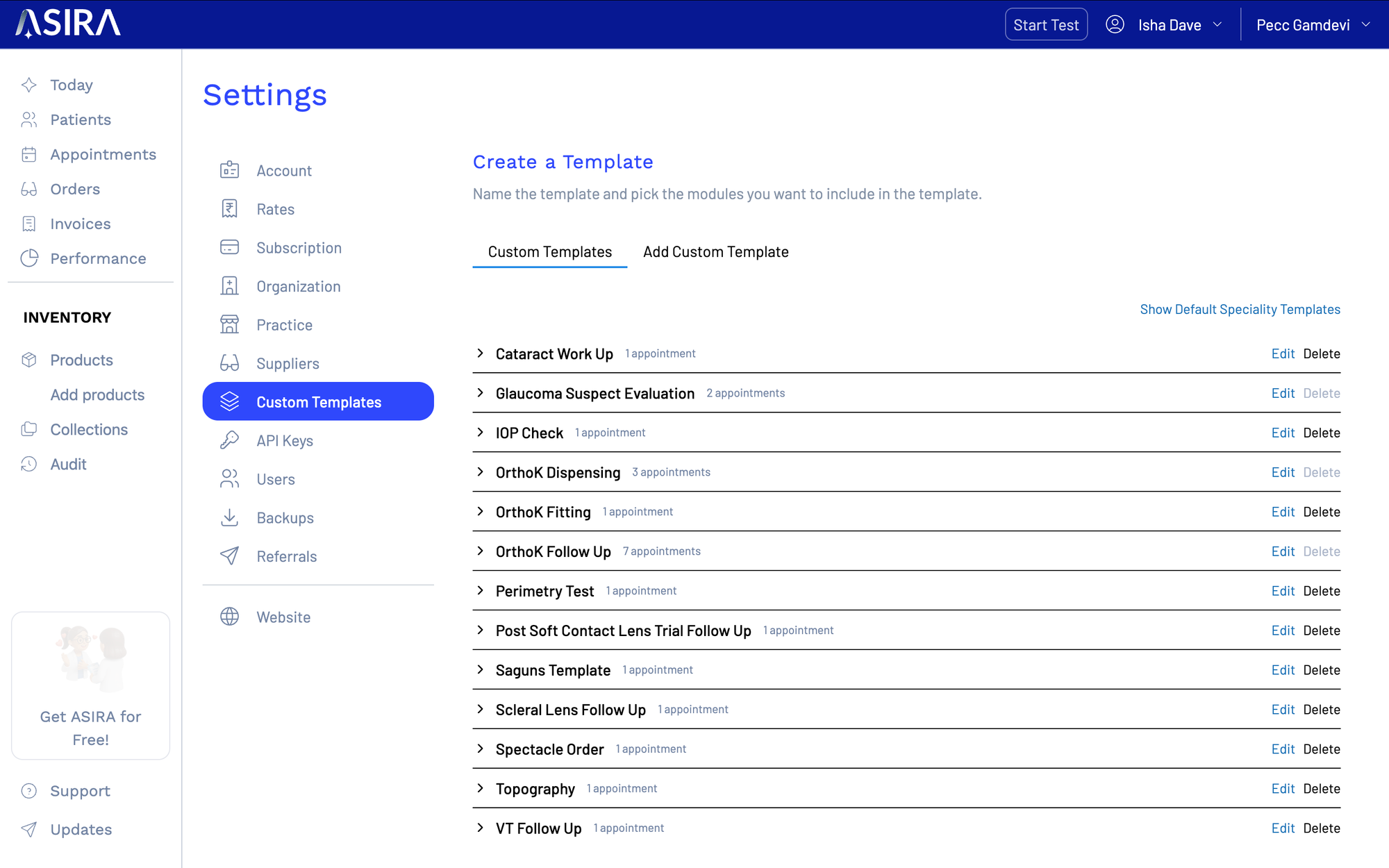
This becomes particularly valuable in practices with multiple clinicians, where standardised documentation helps ensure every patient receives the same high standard of care regardless of which practitioner they see.
Templates improve efficiency without sacrificing quality
Many clinicians worry that structured documentation takes longer. In practice, the opposite is often true. Once familiar with a well-designed template, practitioners spend less time deciding what to record and more time interacting with the patient The consultation becomes more conversational because documentation follows a logical clinical flow. Over time, this creates additional benefits:
- Practices can audit outcomes.
- Common diagnoses become easier to identify.
- Follow-up compliance can be monitored.
- Clinical performance trends become visible.
Supporting education and professional development
Clinical templates are particularly valuable for newly qualified optometrists and students. Experienced practitioners often perform comprehensive examinations instinctively, but students are still developing those habits.
Structured templates reinforce good examination techniques while helping students understand the logical progression from history to examination to diagnosis and management, hence, rather than memorising isolated tests, they learn systematic clinical reasoning.
This also creates opportunities for mentoring where supervisors can review structured records, identify gaps in documentation and provide targeted feedback that accelerates clinical development.
Looking ahead
Artificial intelligence is receiving considerable attention in eye care, but its success depends entirely on the quality of the information it receives. Incomplete or inconsistent clinical records limit the usefulness of any decision-support system. Structured documentation creates high-quality clinical datasets that can support future technologies while improving patient care today. Whether those technologies involve disease prediction, automated risk stratification or clinical decision support, they all begin with reliable data.
Conclusion
Clinical templates will never replace clinical expertise. They cannot diagnose disease, interpret subtle findings or replace professional judgement. What they can do is help ensure that every examination is thorough, every important finding is documented and every patient benefits from a consistent standard of care.
For independent optometrists, that means greater confidence in decision-making, improved continuity of care and more meaningful clinical records over time. For practices, it means greater consistency across clinicians, stronger documentation and the ability to use practice data to continuously improve patient care.
At ASIRA, our philosophy has always been simple: technology should support better clinical practice, not complicate it. By combining evidence-based clinical templates with flexible, practitioner-led workflows, ASIRA helps optometrists spend less time worrying about documentation and more time focusing on what matters most: delivering exceptional patient care.
ASIRA is a simple and secure, cloud-based software tool, that helps eye care professionals reduce the time and effort required to maintain clinical records, schedule appointments, generate bills, manage inventory and much more!
To find out more, visit www.asira.health and sign up for a FREE TRIAL!



Comments ()