

Building an Evidence-Based Clinical Protocol for Myopia Management
As the prevalence of childhood myopia continues to rise globally, the focus of modern clinical care has shifted from merely correcting refractive error to actively slowing axial elongation and reducing lifelong ocular morbidity.
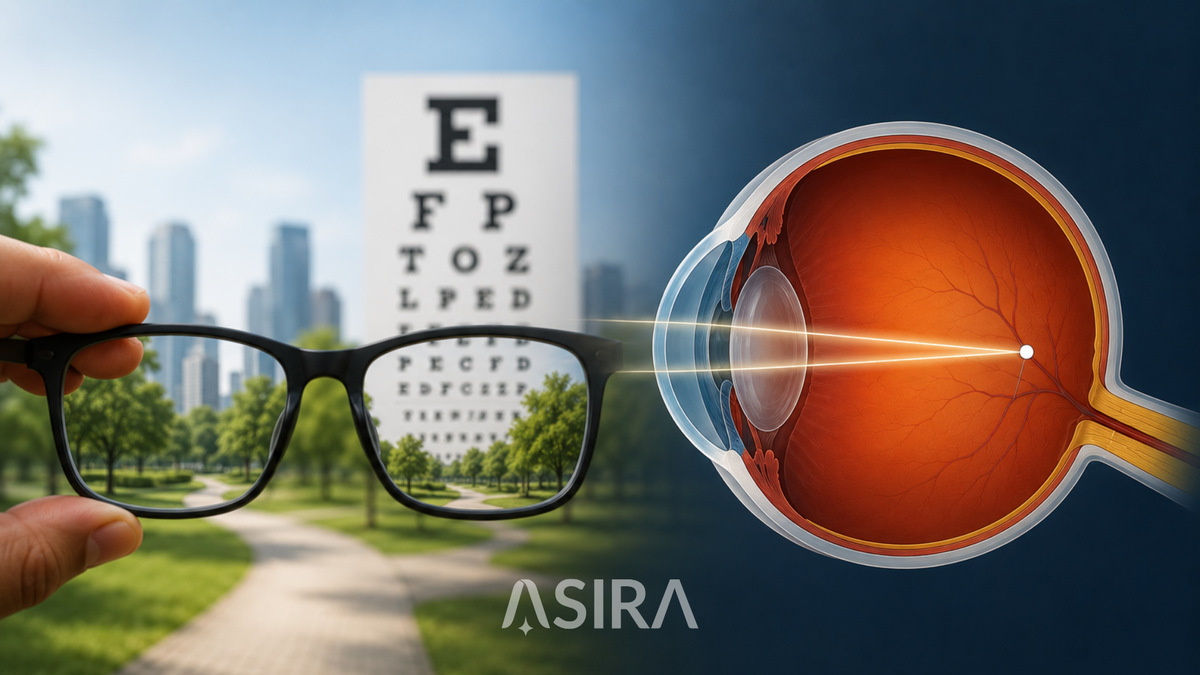
As the prevalence of childhood myopia continues to rise globally, clinicians are increasingly recognising that simply prescribing single vision spectacles is no longer sufficient. Myopia is now understood as a progressive ocular condition associated with significant long-term risks including retinal detachment, glaucoma, myopic maculopathy, cataract, and irreversible vision loss. The focus of modern clinical care has therefore shifted from merely correcting refractive error to actively slowing axial elongation and reducing lifelong ocular morbidity.
At ASIRA, the Myopia Management Template was developed specifically to support clinicians in delivering structured, evidence-based care. Built around recommendations from the International Myopia Institute (IMI) Clinical Management Guidelines and incorporating practical frameworks such as the IMPACT Myopia Management Guidelines, the ASIRA workflow helps practitioners standardize examinations, identify progressive axial myopia accurately, document risk factors systematically, and monitor treatment outcomes consistently over time.
The importance of standardized protocols cannot be overstated. One of the biggest challenges in clinical myopia management today is determining when to intervene, which treatment to choose, and how to monitor progression appropriately. The recently proposed IMPACT Guidelines from the L V Prasad Eye Institute provide a particularly practical framework for clinicians by outlining a six-step systematic approach to myopia management:
- Identify true axial myopia
- Map risk factors
- Pick progressive myopes
- Appropriate treatment strategy
- Consult, counsel, combine and monitor closely
- Taper and cessation of treatment
These principles align closely with the philosophy behind the ASIRA Myopia Management Template and the evidence-based recommendations outlined in the IMI white papers.
Step 1: Identify True Axial Myopia
The first and perhaps most critical step in any myopia management protocol is confirming that the patient has true axial myopia rather than refractive or secondary myopia.
The IMPACT Guidelines specifically emphasize the need to rule out refractive, corneal, and pseudo-myopia before initiating any intervention.
This is clinically important because not all increases in minus power represent pathological axial elongation. A child may appear more myopic because of:
- Corneal steepening
- Accommodative spasm
- Lenticular changes
- Instrument variability
- Pseudomyopia
For example, a patient with steep corneal curvature but relatively short axial length may not actually have progressive axial myopia. Similarly, accommodative spasm can create transient myopic findings that should not trigger aggressive myopia control interventions.
This is why evidence-based protocols require correlation between:
- Cycloplegic refraction
- Keratometry
- Corneal topography
- Axial length measurements
before making treatment decisions.
The IMI Clinical Management Guidelines similarly emphasize cycloplegic refraction and axial length evaluation as essential components of baseline examination.
Within the ASIRA Myopia Management Template, clinicians are guided through structured documentation of:
- Cycloplegic refraction
- Axial length
- Corneal topography
- Keratometry findings
- Retinal evaluation
ensuring that true axial myopia is differentiated from other refractive causes before intervention is initiated.
Step 2: Mapping Risk Factors
Modern myopia management is heavily risk-factor driven.
The IMPACT Guidelines recommend holistically documenting risk factors to better understand the mechanisms contributing to onset and progression.
Important risk factors include:
- Myopic parents
- Early onset of myopia
- Reduced outdoor time
- Excessive near work
- High accommodative lag
- Near esophoria
- Relative peripheral hyperopia
The IMI white papers also emphasize that both environmental and genetic influences contribute significantly to childhood myopia development.
Children with two myopic parents are known to have substantially higher risk of becoming myopic themselves, while excessive near work and limited outdoor exposure have repeatedly been associated with both onset and progression.
This risk-factor-based approach is essential because myopia management is not a “one-size-fits-all” model. Different children may require different interventions depending on the mechanisms driving their progression.
Step 3: Identifying the Progressive Myope
Not every myope requires active myopia control intervention.
The IMPACT Guidelines recommend identifying patients with progressive axial elongation or clinically meaningful refractive progression before initiating treatment.
Suggested cut-offs include:
- Axial elongation greater than 0.1 mm/year
- Refractive progression greater than 0.50 D/year
This distinction is extremely important clinically. Some patients may remain relatively stable and may not benefit significantly from aggressive intervention.
However, rapidly progressing children, particularly younger children, are at much greater risk of developing high myopia and associated pathology later in life.
The IMI guidelines similarly emphasize that younger onset is associated with faster progression and higher final myopia levels.
Step 4: Choosing an Appropriate Treatment Strategy
Once true progressive axial myopia has been identified, the next step is selecting the most appropriate intervention.
The IMPACT Guidelines strongly advise against “shooting in the dark” and instead recommend tailoring treatment based on individual risk factors and clinical findings.
This is where comprehensive clinical examination becomes particularly important.
The Importance of Binocular Vision Assessment
One of the most commonly overlooked aspects of myopia management is binocular vision evaluation.
The IMI Clinical Management Guidelines emphasize that accommodative and vergence anomalies are frequently associated with progressive myopia.
These may include:
- Accommodative lag
- Reduced accommodative facility
- Esophoria at near
- Elevated AC/A ratios
- Convergence abnormalities
Before prescribing any intervention, clinicians should assess:
- Near point of convergence
- Accommodative amplitude
- Accommodative facility
- MEM retinoscopy
- Cover test findings
- Near phorias
- Ocular motility
- AC/A ratio
Importantly, some myopia control treatments themselves can alter binocular vision function. Orthokeratology, multifocal soft contact lenses, and atropine may all affect accommodation and vergence systems.
A child with high accommodative lag or near esophoria may benefit more from interventions that reduce accommodative stress, such as bifocals, progressive addition lenses, or specific multifocal contact lens designs.
The ASIRA Myopia Management Template specifically incorporates these binocular vision assessments within the workflow, including:
- Near point of convergence
- Accommodative facility
- MEM findings
- Cover test
- Maddox rod
- Ocular motility
This helps ensure that clinicians do not overlook accommodative or vergence issues before initiating treatment.
Discussing Lifestyle Changes With Parents
An evidence-based myopia management protocol must include environmental counselling.
The IMI white papers strongly emphasize the relationship between visual environment and myopia progression.
Outdoor Time
Children who spend more time outdoors demonstrate lower rates of myopia onset. Current evidence suggests that approximately 8-15 hours of outdoor activity weekly may provide meaningful protective benefit.
Parents should therefore be encouraged to:
- Increase outdoor play
- Promote natural light exposure
- Balance indoor and outdoor activities
Near Work and Screen Use
The IMI guidelines also identify prolonged near work and very close working distances as significant risk factors.
Practical advice includes:
- Maintaining appropriate reading distance
- Taking regular breaks every 30-45 minutes
- Limiting continuous screen exposure
- Encouraging distance fixation changes
These recommendations are simple but form a crucial component of long-term management.
Discussing Interventions With Parents
Parents must clearly understand that myopia control aims to slow progression rather than permanently stop or reverse myopia.
The IMI white papers emphasize informed consent and realistic expectations.
Evidence-based interventions include:
Orthokeratology
Multifocal Soft Contact Lenses
Extended Depth of Focus Soft Contact Lenses
DIMS / HALT / CARE Spectacle Lenses
Progressive / Bifocal Spectacle Lenses
Low-Dose Atropine
Treatment choice should ultimately depend on:
- Age
- Progression rate
- Axial length changes
- Binocular vision findings
- Lifestyle
- Compliance
- Family preferences
- Affordability

Monitoring and Follow-Up
Myopia management is not a single prescription event. It is a longitudinal care process.
The IMI guidelines recommend follow-up at least every six months to monitor:
- Axial elongation
- Refractive progression
- Ocular health
- Compliance
- Treatment efficacy
The IMPACT Guidelines similarly emphasize regular review and modification of treatment when progression remains uncontrolled.
Combination therapy may be considered for poor responders, and lifestyle modifications should continue regardless of optical or pharmacological treatment selection.
Conclusion
Modern myopia management requires a structured, evidence-based clinical approach rather than isolated treatment decisions.
The IMPACT Guidelines provide clinicians with a practical framework for identifying true axial myopia, assessing risk factors, selecting appropriate interventions, and monitoring progression systematically. Combined with the evidence-based recommendations from the IMI Clinical Management Guidelines, they help clinicians move beyond simple refractive correction toward comprehensive long-term ocular health management.
The ASIRA Myopia Management Template was developed specifically around these principles, helping clinicians standardize clinical examinations, incorporate binocular vision assessment, document risk factors comprehensively, and monitor progression consistently over time.
As childhood myopia continues to increase globally, evidence-based digital workflows such as the ASIRA Myopia Management Template will play an increasingly important role in helping clinicians deliver safer, more consistent, and more effective myopia management care.
References
- Verkicharla PK, Thakur S, Kekunnaya R, et al. The “IMPACT” myopia management guidelines. Indian J Ophthalmol. 2023;71:2882-2884.
- Gifford KL, Richdale K, Kang P, et al. IMI – Clinical Management Guidelines Report. Invest Ophthalmol Vis Sci. 2019;60(3):M184-M203.
- International Myopia Institute Clinical Management Guidelines.
ASIRA is a simple and secure, cloud-based software tool, that helps eye care professionals reduce the time and effort required to maintain clinical records, schedule appointments, generate bills, manage inventory and much more!
To find out more, visit www.asira.health and sign up for a FREE TRIAL!


Comments ()