
Artificial Intelligence and Clinical Decision Making in Optometric Practice
Artificial intelligence is no longer a futuristic concept in eye care. It is already transforming how optometrists diagnose disease, manage patients, interpret imaging, and make clinical decisions.
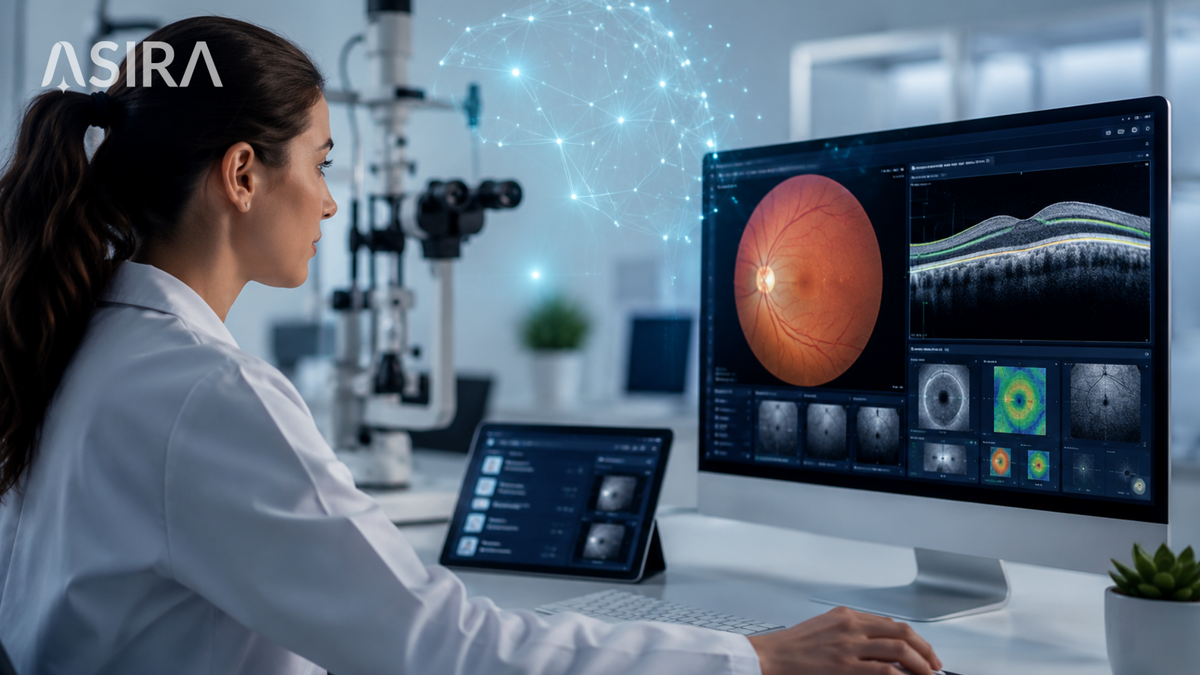
Artificial intelligence is no longer a futuristic concept in eye care. It is already transforming how optometrists diagnose disease, manage patients, interpret imaging, and make clinical decisions. From OCT analysis to retinal disease screening and automated documentation, AI is becoming deeply integrated into modern optometric practice.
But while the technology is advancing rapidly, there is still a major challenge facing the profession: many optometry students and young practitioners do not yet feel prepared to use AI confidently in clinical settings.
A recent UK-based study titled “Attitudes and Knowledge Levels of Optometry Students and Educators Towards Artificial Intelligence in Optometric Practice” highlighted an important reality. Most optometry students currently have very limited knowledge of AI applications in optometry, despite recognising that these technologies will become increasingly important in clinical practice. The study found that 96% of students surveyed had received no formal AI training, and over 75% reported minimal or no knowledge about AI in optometry.
This gap between technological advancement and clinical confidence presents both a challenge and an opportunity.
At ASIRA, we believe AI should not replace optometrists. It should support them, strengthen clinical reasoning, reduce uncertainty, and help practitioners deliver safer and more confident patient care. That is exactly why ASIRA’s AI-powered assistant was developed.
AI Is Changing Optometry Faster Than Education Is
Modern optometry already relies heavily on technology. OCT imaging, topography, automated visual fields, retinal imaging, dry eye analysis systems, and myopia management tools are now standard in many practices.
Artificial intelligence is the next evolution of these systems.
AI can assist practitioners by:
- Identifying patterns in retinal imaging
- Flagging suspicious pathology
- Supporting differential diagnosis
- Improving referral pathways
- Reducing documentation burden
- Enhancing consistency in clinical decision-making
- Providing educational support for practitioners
Research increasingly shows that AI tools can improve efficiency and reduce the likelihood of missed pathology when used appropriately alongside clinician judgement.
However, one of the most interesting findings from the recent survey was not simply that students lacked knowledge. It was that students who had undergone even limited AI training reported significantly greater confidence, competence, and more positive attitudes towards AI in clinical practice.
In other words, exposure matters.
The more clinicians understand AI, the more effectively they can use it.
The Confidence Gap in Young Optometrists
One of the biggest challenges for students and newly qualified optometrists is clinical decision-making confidence.
Most optometry graduates leave university with strong theoretical knowledge. But real-world practice is different.
Suddenly, they are expected to:
- Interpret complex OCT scans
- Decide whether a patient requires referral
- Differentiate normal anatomical variation from pathology
- Explain management plans confidently to patients
- Make time-sensitive clinical decisions independently
That transition can be intimidating.
The study found that students generally did not feel competent enough to understand how AI tools are used in clinical optometry practice.
This is where AI can become incredibly valuable, not as a replacement for clinical thinking, but as a support system that helps build it.
Why ASIRA Built an AI Assistant for Optometry
ASIRA was built by eye care practitioners who understand the realities of clinical practice.
We know that junior optometrists often second-guess themselves.
We know that students can struggle to connect theory with practical decision-making.
We know that many practitioners work in busy clinics with limited mentorship opportunities.
That is why ASIRA’s AI assistant was designed specifically for eye care workflows.
Rather than acting like a generic chatbot, the AI assistant is integrated into the clinical environment to provide meaningful support during patient care.
The goal is simple:
To help practitioners think more clearly, document more efficiently, and make more confident clinical decisions.

How ASIRA’s AI Assistant Helps Students and Junior Optometrists
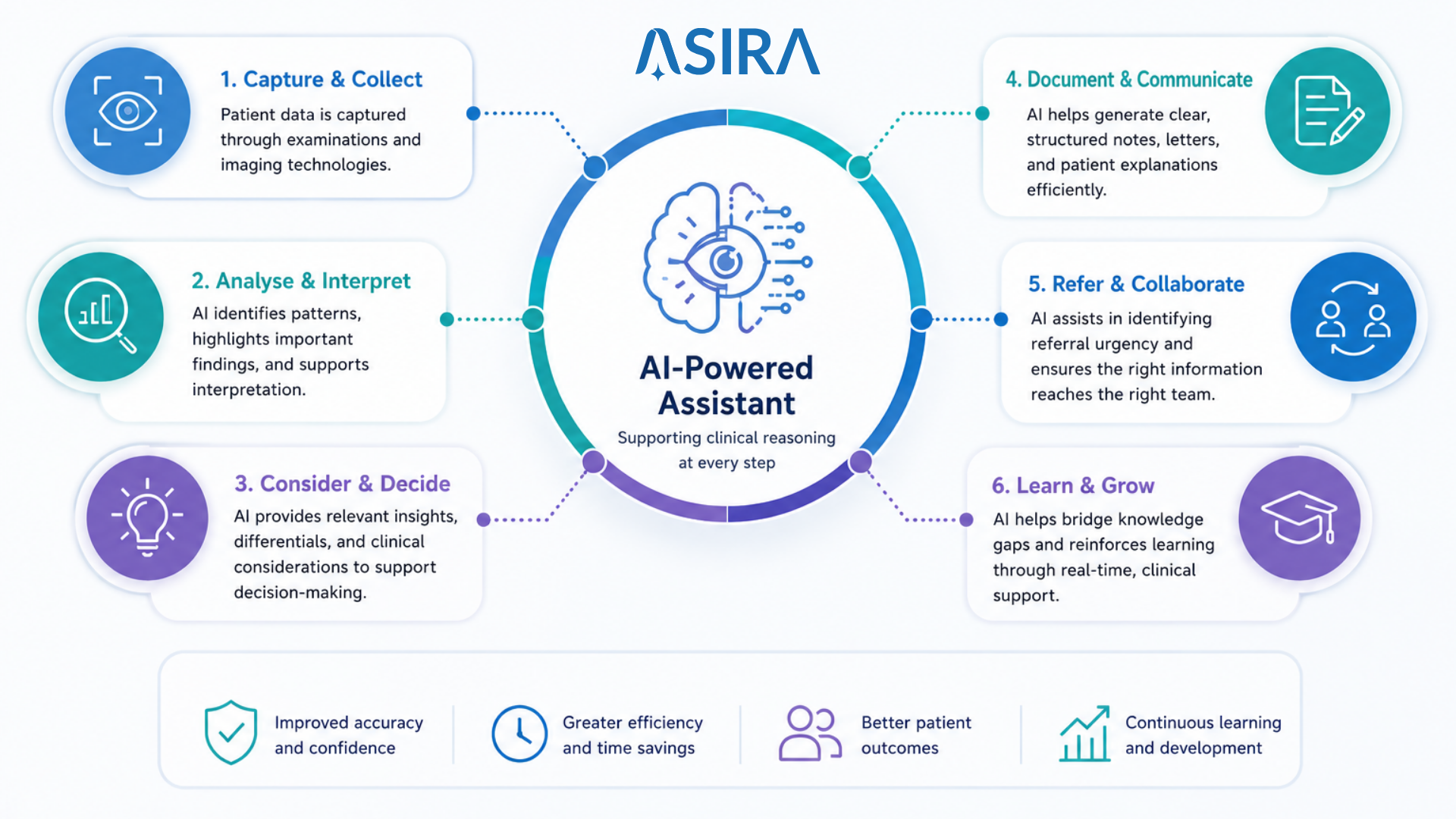
1. Supporting Clinical Reasoning
Clinical decision-making is one of the hardest skills to develop in optometry.
A student may understand glaucoma theoretically, but interpreting subtle RNFL thinning on OCT while correlating visual fields, IOP history, and optic nerve appearance is much more challenging in practice.
ASIRA’s AI assistant helps bridge this gap by assisting practitioners in organising and interpreting clinical information logically.
It can help practitioners:
- Summarise clinical findings
- Identify potential red flags
- Suggest relevant considerations
- Improve consistency in clinical notes
- Support structured thinking during examinations
This does not replace professional judgement. Instead, it reinforces the clinician’s thought process and acts as an additional layer of support.
For junior practitioners, this can dramatically reduce uncertainty and improve confidence.
2. Enhancing Learning During Real Patient Encounters
Traditional education often separates learning from clinical practice.
Students study disease in lectures and textbooks, then attempt to apply that information later in clinic.
AI changes this dynamic.
With tools like ASIRA’s assistant, learning becomes integrated directly into patient care. Clinical encounters become opportunities for guided learning and reinforcement.
For example:
- A student documenting dry eye findings may receive structured guidance on grading severity
- A junior optometrist reviewing retinal imaging may be prompted to consider specific pathology differentials
- A practitioner writing referral notes may receive help improving clarity and completeness
This creates continuous real-world learning.
The research paper specifically highlighted that students believed important AI curriculum topics included learning how to interpret AI outputs, understanding what AI tools are available, and knowing how to use AI ethically and effectively in clinical settings.
ASIRA’s AI assistant addresses exactly these practical needs.
3. Improving Documentation Quality
Clinical documentation is a major source of stress for many new practitioners.
Good notes require:
- Accuracy
- Structure
- Clinical justification
- Appropriate terminology
- Time efficiency
Many junior clinicians struggle with balancing thoroughness and speed.
ASIRA’s AI assistant can help generate structured clinical notes and improve documentation workflows, allowing practitioners to focus more on patient care rather than administrative burden.
This is particularly valuable in busy clinics where time pressure can affect note quality and clinical confidence.
4. Reducing Decision Fatigue
Optometrists make hundreds of decisions every day.
Over time, decision fatigue becomes a real issue, particularly in high-volume practices.
AI assistance can help reduce cognitive overload by:
- Organising information clearly
- Highlighting missing data
- Supporting consistency
- Streamlining repetitive tasks
This does not mean AI makes the decisions.
It means practitioners can make better decisions with less mental strain.
AI Will Not Replace Optometrists
One concern repeatedly raised whenever AI is discussed in healthcare is whether it will eventually replace clinicians.
Interestingly, the study found that students were more likely than educators to worry that AI would reduce the need for optometrists and negatively affect patient relationships.
But the reality is far more nuanced.
Eye care is fundamentally human.
Patients do not simply need diagnostic outputs. They need:
- Communication
- Reassurance
- Empathy
- Clinical judgement
- Ethical decision-making
- Contextual understanding
AI cannot replace these human elements.
What AI can do is help practitioners work more effectively.
The future of optometry is not “AI versus optometrists.”
It is optometrists who understand AI working alongside advanced technology to deliver better patient care.
Those who embrace these tools early will likely have a significant advantage.
The Importance of AI Literacy in Optometry
One of the strongest conclusions from the research was that optometry education must evolve.
Educators strongly agreed that learning about AI should become part of optometry education and training.
This is an important shift.
Future optometrists will need to understand:
- How AI tools function
- How to interpret outputs responsibly
- The limitations of AI
- Ethical considerations
- Data privacy concerns
- When to trust AI and when not to
AI literacy is becoming as important as digital literacy.
At ASIRA, we believe this education should not only happen in universities. It should also happen inside clinical practice itself.
That is why our platform focuses not only on workflow efficiency, but also on supporting practitioner development and clinical confidence.
The Future of AI in Eye Care
Artificial intelligence will continue to evolve rapidly over the coming decade.
We are likely to see:
- Smarter diagnostic support systems
- Improved retinal screening algorithms
- Better predictive analytics
- AI-assisted disease progression monitoring
- More advanced patient communication tools
- Enhanced clinical decision support systems
But technology alone is not enough.
The real value comes from how practitioners use these tools.
Clinicians who understand AI, question it appropriately, and integrate it thoughtfully into patient care will be best positioned for the future of optometry.
ASIRA’s Vision
At ASIRA, our vision is simple:
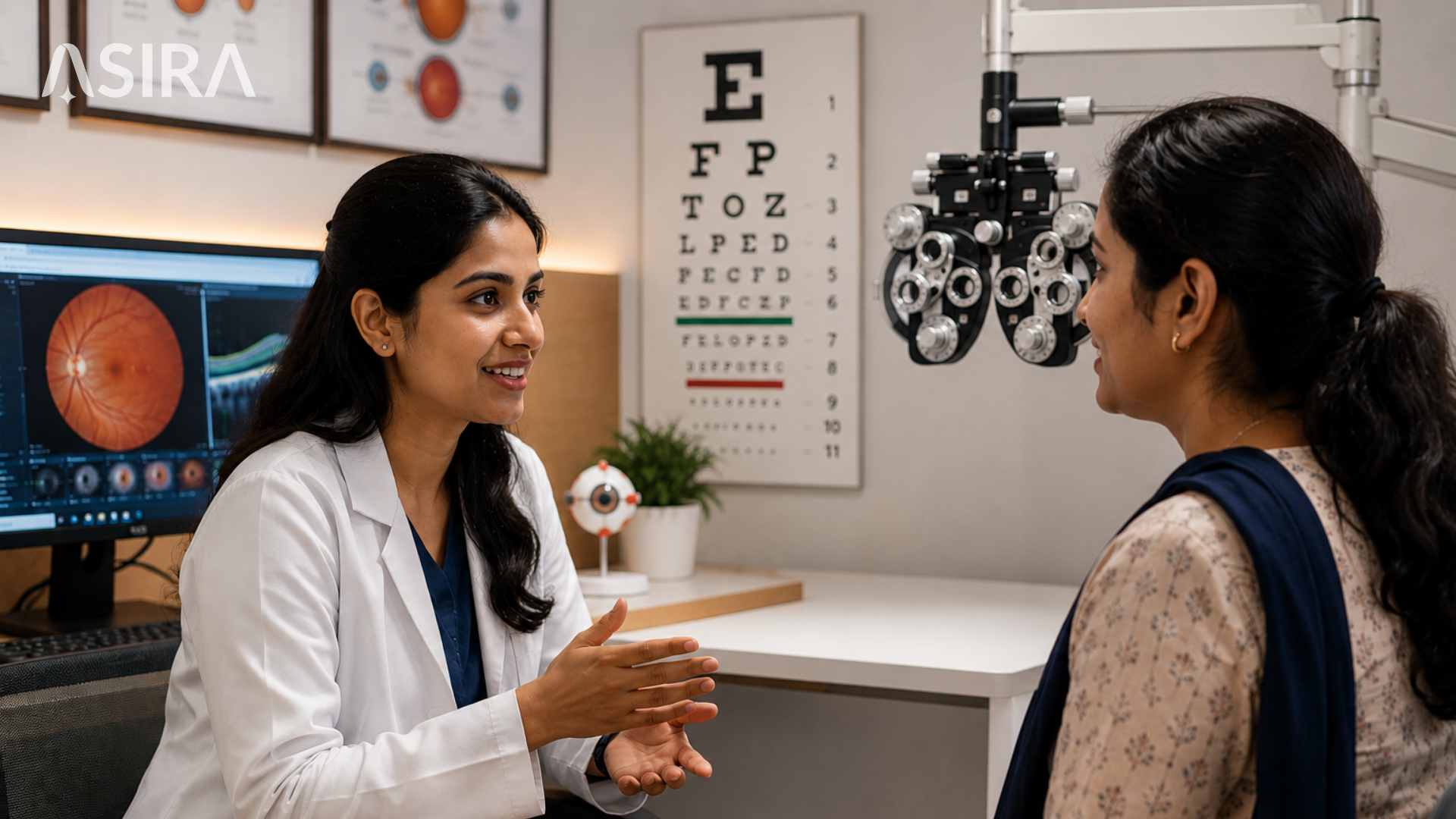
To empower eye care practitioners with technology that genuinely improves clinical practice.
We are not building AI to replace clinicians.
We are building AI to support them.
For students, ASIRA can act as a learning companion.
For junior optometrists, it can provide reassurance and structure.
For experienced clinicians, it can improve efficiency and workflow consistency.
Most importantly, it keeps the practitioner at the centre of decision-making.
The future of optometry will belong to clinicians who combine strong human judgement with intelligent technological support.
AI is not the future of optometry.
AI-assisted optometrists are.
References
- Buckmaster F, van Staden D, Coetzee L. Attitudes and Knowledge Levels of Optometry Students and Educators Towards Artificial Intelligence in Optometric Practice: An Online Cross-Sectional Survey. Ophthalmic and Physiological Optics. 2026.
- Krishnan A, Dutta A, Srivastava A, Konda N, Prakasam RK. Artificial Intelligence in Optometry: Current and Future Perspectives. Clinical Optometry. 2025;17:83–114.
- Murphy TI, Armitage JA, van Wijngaarden P, Abel LA, Douglass AG. A Guide to Optometrists for Appraising and Using Artificial Intelligence in Clinical Practice. Clinical and Experimental Optometry. 2023;106:569–579.
- Aslam TM, Hoyle DC. Translating the Machine: Skills That Human Clinicians Must Develop in the Era of Artificial Intelligence. Ophthalmology and Therapy. 2021;11:69–80.
- Chou YB, Kale AU, Lanzetta P, Aslam T, Barratt J, Danese C, et al. Current Status and Practical Considerations of Artificial Intelligence Use in Screening and Diagnosing Retinal Diseases: Vision Academy Retinal Expert Consensus. Current Opinion in Ophthalmology. 2023;34:403–413.
- Danese C, Kale AU, Aslam T, Lanzetta P, Barratt J, Chou YB, et al. The Impact of Artificial Intelligence on Retinal Disease Management: Vision Academy Retinal Expert Consensus. Current Opinion in Ophthalmology. 2023;34:396–402.
- Patel NR, Lacher CR, Huang AY, Kolomeyer A, Bavinger JC, Carroll RM, et al. Evaluating the Application of Artificial Intelligence and Ambient Listening to Generate Medical Notes in Vitreoretinal Clinic Encounters. Clinical Ophthalmology. 2025;19:1763–1769.
- Long D, Magerko B. What is AI Literacy? Competencies and Design Considerations. Proceedings of the 2020 CHI Conference on Human Factors in Computing Systems. Association for Computing Machinery; 2020.
- Kelly CJ, Karthikesalingam A, Suleyman M, Corrado G, King D. Key Challenges for Delivering Clinical Impact with Artificial Intelligence. BMC Medicine. 2019;17:195.
- College of Optometrists. Shaping the Future: The AI in Eye Care Summit. 2025.
ASIRA is a simple and secure, cloud-based software tool, that helps eye care professionals reduce the time and effort required to maintain clinical records, schedule appointments, generate bills, manage inventory and much more!
To find out more, visit www.asira.health and sign up for a FREE TRIAL!
Comments ()