Where Is Your Optometry Practice Actually Losing Money?
Where is your practice losing money? Discover the hidden operational leakages affecting appointments, follow-ups, inventory, billing, and revenue, and how ASIRA helps.
A busy optometry practice can create the impression that business is healthy. The appointment book is full, patients are being examined, spectacles are being dispensed and the team is constantly occupied. Yet, at the end of the month, the numbers may not reflect that level of activity.
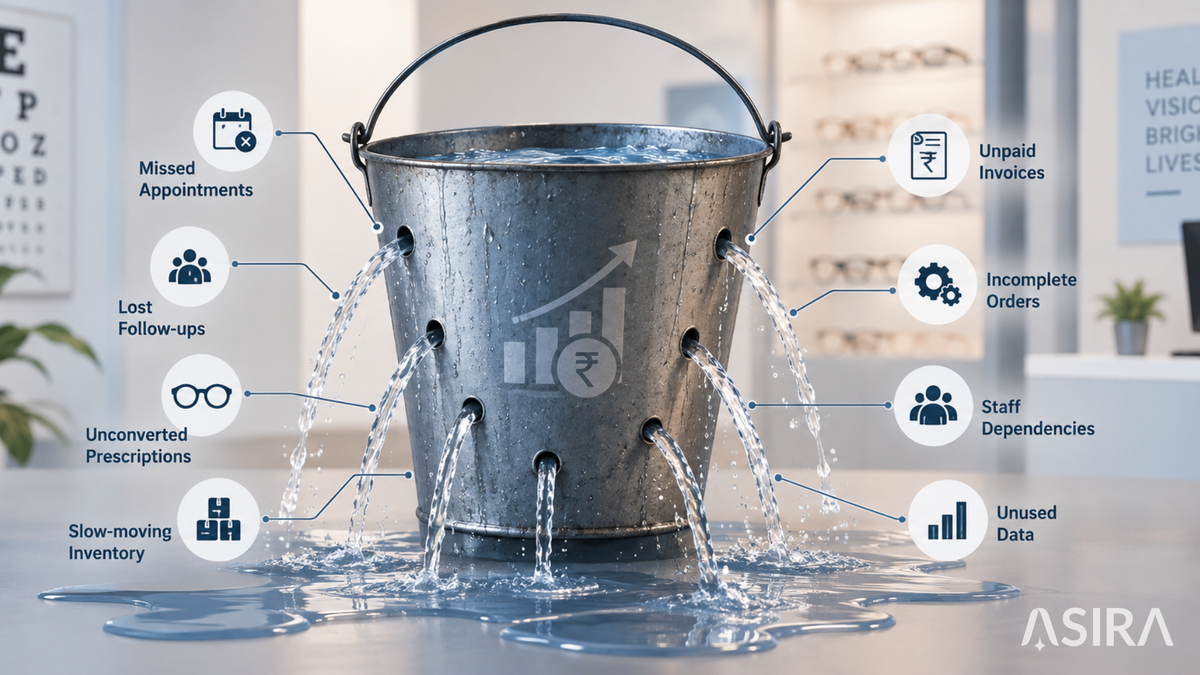
Revenue does not always disappear through one obvious mistake. More often, it leaks away through small gaps in everyday operations. A missed appointment, an incomplete sale, an unpaid invoice, an overlooked follow-up or a frame that remains on the shelf for years may seem insignificant individually. Together, however, these small losses can have a meaningful impact on profitability.The challenge is that most practice owners notice revenue leakage only after it appears in the accounts. By then, the opportunity to recover it may already have passed.
So where should you look?
The appointment leakage
Every empty appointment slot represents more than an unused space in the diary. It represents clinical time, staff availability and potential revenue that cannot be recovered once the day has passed. No-shows, late cancellations, poorly managed appointment gaps and patients who enquire but never complete a booking can all contribute to this leakage. In smaller practices, appointment management is often handled manually, with staff relying on phone calls, messages, spreadsheets or memory.
The problem is not always a lack of patient demand. Sometimes, it is a lack of visibility. If the practice does not track cancellations, no-shows, unconfirmed appointments and unfilled slots, it becomes difficult to understand how much capacity is being lost or identify patterns that could be addressed.
ASIRA's appointment management features help practices maintain a clearer view of their schedules, patient bookings and appointment status. By bringing appointments into a shared system, the team can identify gaps, manage bookings more consistently and reduce dependence on individual staff members remembering who needs to be contacted.
The first leakage to investigate, therefore, is not how many appointments the practice has booked. It is how many potential appointments never actually happen.
The patient retention leakage
Acquiring a new patient requires time, effort and marketing investment. Yet many practices pay far less attention to what happens after the first consultation. Patients may need a routine eye examination, a contact lens review, a myopia management assessment, a dry eye follow-up or monitoring for an existing condition. If the practice does not have a reliable recall process, these patients may simply disappear from the schedule. They may not have had a negative experience. They may simply have forgotten.
Manual recall systems are particularly vulnerable to this problem. A reminder may depend on a receptionist remembering the due date, checking a register or reviewing old files. As patient numbers increase, this becomes increasingly difficult to manage consistently.
ASIRA connects patient records with appointment and follow-up workflows, making it easier for the team to identify patients who are due for review. Instead of relying entirely on memory or separate registers, the practice can build follow-up into the patient's ongoing clinical journey. This is particularly valuable for services that depend on continuity, such as contact lens care, myopia management and chronic ocular surface conditions.
Missed follow-ups create both clinical and commercial leakage. The patient may lose continuity of care, while the practice loses a future consultation, optical opportunity or contact lens sale.
The prescription-to-purchase leakage
One of the most significant opportunities in an optometry practice occurs when a patient receives a prescription but does not purchase their eyewear from the practice. The clinical service has already been delivered. The optometrist has invested time in the examination, the patient has received a recommendation and an optical need has been identified. Yet the patient may leave with a prescription and purchase elsewhere.
This does not mean every patient should be pressured to buy from the practice. Patients should always be free to make their own decisions. However, practices should understand how effectively they are connecting clinical recommendations with appropriate optical solutions. A weak handover between the consulting room and dispensing area can contribute to this leakage. The patient may not be introduced to the optical team, their visual requirements may not be communicated clearly, or the dispensing staff may not understand the clinical reasoning behind the recommendation.
ASIRA helps connect clinical records with optical orders, allowing relevant patient information and recommendations to remain accessible beyond the consultation room. When the optical team understands the patient's visual needs, lifestyle and clinical recommendations, they are better placed to provide an informed and appropriate dispensing experience.
The objective is not to sell unnecessary products. It is to ensure that appropriate clinical recommendations are not lost during the transition from examination to dispensing.
The missed follow-through leakage
Sometimes, the patient does intend to purchase from the practice, but the process breaks down before the order is completed. A patient may be waiting for a quotation, confirmation of lens availability, an update from the laboratory or a response to a question. If nobody follows up, the order may remain incomplete. This is especially common when information is spread across notebooks, WhatsApp messages, spreadsheets and individual staff members' memories.
The practice may believe that the patient is still considering their options. The patient, meanwhile, may assume that the practice is not interested or may move to another provider. Every incomplete order deserves attention.
ASIRA's task management and order workflows can help practices track pending actions and make responsibilities more visible. Whether the next step involves contacting a patient, confirming product availability, updating an order or following up on a quotation, the task can be recorded rather than left to memory. This makes it easier for the team to see what is pending and who is responsible for moving it forward.
The leakage here is not necessarily caused by poor salesmanship. It is often caused by poor follow-through.
The inventory leakage
Inventory is one of the most visible assets in an optical practice, but it can also be one of the least understood sources of financial leakage. Frames that do not sell tie up capital. Excess stock occupies display and storage space. Popular products may be unavailable when patients want them, while slow-moving products continue to accumulate unnoticed. There is also the risk of expired contact lenses, duplicated purchasing, inaccurate stock counts and stock that cannot be located when required.
Inventory problems are particularly difficult to identify when purchasing decisions are based mainly on intuition. A frame may have been purchased because it looked appealing, a supplier recommended it or it seemed like a good deal. But unless its performance is reviewed, the practice may not know whether it is contributing to revenue or simply occupying space.
ASIRA's inventory management features help practices bring greater structure to stock control. By connecting inventory with optical orders and dispensing activity, practices can monitor product movement, identify slow-moving items and make purchasing decisions using actual sales information. The goal is not to maintain the largest inventory. It is to maintain the right inventory, with enough variety to meet patient needs without unnecessarily tying up working capital.
The billing and collection leakage
Revenue that has been earned but not collected is another common source of leakage. Billing errors, incomplete invoices, missed charges, incorrect discounts and unpaid balances can all affect cash flow. In a busy practice, staff may be focused on the next patient and fail to notice that an invoice was not completed correctly or that a payment remains outstanding. Small discrepancies can accumulate over time.
Manual billing also makes it difficult to reconcile consultation fees, optical orders, contact lens purchases and other services. When billing information is maintained separately from patient and order records, identifying what has been paid, what is pending and what remains outstanding becomes more complicated.
ASIRA's billing workflows help practices connect invoices and payments with the relevant patient, consultation or order. This provides the team with greater visibility into completed transactions, outstanding amounts and the financial status of each order.
The important distinction is between revenue recorded on paper and money that actually reaches the practice's bank account.
The staff dependency leakage
Some practices function well only because one or two experienced employees know how everything works. They remember which patients need to be contacted, where orders are pending, how discounts are applied, which suppliers are reliable and how specific processes are completed. This knowledge is valuable, but when it exists only in people's heads, it creates operational risk.
If that employee is absent, resigns or becomes overwhelmed, important tasks may be delayed or missed. New staff may struggle to understand the workflow, and the practice becomes dependent on individual memory rather than a repeatable system.
ASIRA helps convert individual knowledge into shared practice information. Patient records, appointment details, orders, billing information and tasks can be accessed by authorized team members, reducing the need to depend on one person's personal notes or memory.
This also makes staff training and handovers easier. When processes are documented and information is accessible, the practice becomes less vulnerable to disruption when team members change.
The data leakage
Perhaps the most difficult leakage to identify is the information that the practice collects but never uses. Most practices generate valuable data every day. They know how many patients were seen, which services were provided, how many orders were placed and how much revenue was generated. But if this information is not reviewed in a meaningful way, it remains little more than a record of what has already happened.
Practice data can answer important questions. Which services are growing? How many patients do not return for follow-up? What percentage of prescriptions are converted into optical orders? Which products are selling consistently? Which staff members need additional support? Without this visibility, practice owners are forced to make decisions based on impressions. A practice may feel busy while a particular service is underperforming. A product category may appear popular while generating little margin. A staff member may seem productive while important follow-ups remain incomplete.
ASIRA's performance and reporting features bring clinical, appointment, order and billing information together to help practice owners identify these patterns. Instead of looking at isolated numbers, they can develop a more complete understanding of how the practice is functioning.
Data does not solve problems by itself. But it helps identify where the problems are.
Plugging the leaks requires visibility first
The purpose of identifying revenue leakage is not to turn every patient interaction into a sales calculation. A successful eye-care practice must remain centred on clinical quality, patient trust and appropriate care. However, financial sustainability is also important. A practice that continually loses revenue through preventable operational gaps may struggle to invest in staff, equipment, training and better patient services.
The first step is to stop assuming that revenue leakage is always caused by insufficient patient numbers. Sometimes, the demand already exists. The problem is that the practice is not consistently converting activity into completed appointments, appropriate optical solutions, collected payments, repeat visits or informed business decisions.
ASIRA helps practices address these gaps by connecting the different parts of everyday operations. Appointment management, clinical documentation, billing, optical orders, inventory, tasks and performance reporting work together rather than remaining isolated processes.
When information is connected, missed actions become easier to identify. When responsibilities are visible, follow-through improves. When performance can be measured, decisions become more informed.
The question worth asking
Where is your practice actually losing money? Not in theory, and not only on the profit and loss statement. Look at the patient journey from the first enquiry to the appointment, examination, prescription, purchase, payment and follow-up. Every stage presents an opportunity to provide better care, and every stage can also contain a leakage.
The goal is not to eliminate every lost opportunity. That would be unrealistic. The goal is to identify the preventable gaps, understand their impact and build systems that help your team act before small losses become significant ones. A practice does not always need more patients to improve its financial performance. Sometimes, it simply needs to stop losing the value it is already creating.
ASIRA is a cloud-based EMR and practice management software built by eye care professionals for eye care professionals. We have helped hundreds of practices change the way they work. To find out more, visit www.asira.health and sign up for a FREE TRIAL!

Comments ()