

From Optical Shop to Primary Eye-Care Centre
India’s optometry model is evolving, as optical practices become more clinical, education advances, regulation strengthens, and a new generation reshapes the profession.
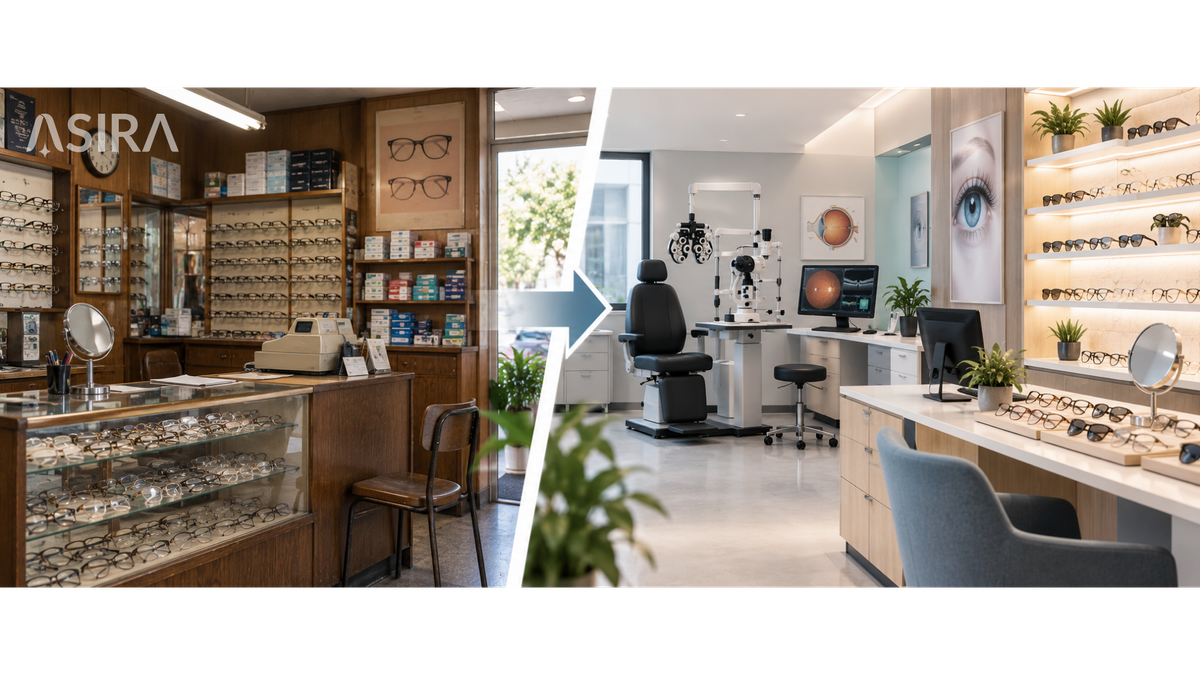
For decades, the Indian optical shop has often been the most visible face of eye care. A patient walked in because they could not see clearly, had broken their spectacles, wanted a new frame or needed a contact lens. The optician or optometrist became the first point of contact, and for many patients, that interaction was the beginning and end of their eye-care journey.
That model is changing. Across India, the optical outlet is increasingly becoming something more than a place to buy spectacles. More practices are beginning to look and function like primary eye-care centres, with comprehensive eye examinations, ocular health assessment, diagnostic technology, contact lens services, myopia management, dry eye care, low vision services and structured referral pathways becoming part of the conversation.
This shift is not happening because the optical industry has suddenly decided to become clinical. It is being driven by a much larger change in the profession itself. Optometry is becoming more formally regulated, optometry education is becoming more standardized, technology is making advanced clinical assessment more accessible, and a younger generation of optometrists is entering the profession with different expectations of what their career can look like.
A profession moving beyond refraction
The traditional perception of an Indian optometrist has often been closely tied to refraction and spectacle dispensing. That is understandable. These services remain fundamental to optometry and continue to represent a large part of everyday practice. But they do not represent the full potential of the profession.
Research into optometry practice in India has already shown that optometrists work across hospitals, academia, optical retail and community settings, with many working across more than one mode of practice. The opportunity now is to build a stronger primary eye-care model around the optometrist.
Primary eye care is particularly important in a country as large and diverse as India. A patient should not necessarily have to reach a tertiary eye hospital to have an eye health concern identified. The primary level should be able to perform a meaningful examination, recognise common eye conditions, identify risk, provide appropriate management within scope and, most importantly, know when and where to refer. India has already demonstrated the value of this approach through vision-centre models. These centres have provided refraction, spectacle dispensing, identification of common eye conditions and referral to higher levels of care, often supported by teleophthalmology and links with larger hospitals. One major review of vision centres across several Indian eye-care networks described more than 300 centres serving as extensions of larger hospital systems.
The next question is whether more conventional optical practices can evolve in the same direction.
The five-year optometry degree changes the starting point
One of the biggest changes taking place is in optometry education. Under the new NCAHP framework, the Bachelor of Optometry is moving to a five-year programme comprising four years of academic and clinical education followed by a one-year internship. The programme is being introduced from the 2026-27 academic year.
This is more than simply adding another year to a degree. The move towards a competency-based curriculum represents an attempt to create greater consistency in what an optometry graduate should know and be able to do. The NCAHP competency-based optometry curriculum was launched as part of the broader reform of allied and healthcare education, with optometry specifically included among the professions covered. That matters because the future of primary eye care depends heavily on the capabilities of the person sitting at the front line.
If the profession expects optometrists to become genuine primary eye-care providers, education has to prepare them for more than producing an accurate spectacle prescription. It has to develop clinical reasoning, patient communication, ocular health assessment, interpretation of investigations, recognition of pathology, referral decision-making and the ability to work as part of a wider healthcare system.
A recent review of optometric education in India described the country's young and geographically diverse optometry workforce as a major strength, while also identifying inconsistent curriculum implementation and infrequent curricular updates as challenges. The new competency-based framework provides an opportunity to address some of these longstanding issues. The real test, however, will not be what is written in the curriculum. It will be how consistently that curriculum translates into clinical competence across institutions and, ultimately, into practice.
What the NCAHP Act changes
The National Commission for Allied and Healthcare Professions Act has the potential to be one of the most important developments in the history of Indian optometry. For years, optometry developed rapidly but without the same level of national regulatory structure that exists for many other healthcare professions. The NCAHP Act creates a statutory framework for allied and healthcare professions and brings greater focus to education, professional standards, registration and workforce planning.
The change is already moving from legislation into implementation. The government reported in 2026 that NCAHP had finalised competency-based curricula and that 29 States and Union Territories had constituted State Allied and Healthcare Councils. The government has also begun building systems for professional and institutional enrolment and workforce mapping. For optometrists, regulation has an important symbolic effect as well as a practical one. It reinforces the idea that optometry is a healthcare profession, not simply an extension of optical retail.
That distinction matters. An optical business can exist primarily around products. A primary eye-care practice has to exist primarily around patients. Of course, regulation alone will not change practice. A registration number does not automatically create clinical competence, and a five-year degree does not automatically create a primary eye-care centre. The profession still needs appropriate infrastructure, clinical supervision, continuing education, referral networks and practice models that allow optometrists to use their training. But the regulatory foundation is important because it gives the profession a clearer framework on which to build.
The patient is changing too
There is another force behind this transition that is easy to overlook: the Indian patient is becoming more informed. Patients are increasingly aware of myopia, glaucoma, diabetic eye disease, dry eye, children's vision, contact lenses and the importance of regular eye examinations. They are also more willing to ask questions about why a particular test is being performed and what their results mean. This changes the role of the optometrist.
The patient who walks into an optical store asking for "power" may actually need a comprehensive eye examination. The person who thinks their fluctuating vision is simply a change in spectacle power may have dry eye or another underlying issue. A child brought in for a new pair of glasses may need a broader assessment of binocular vision or visual development. The optical transaction may still happen at the end of the appointment, but the clinical conversation needs to come first.
A younger generation with different expectations
Perhaps the most interesting part of this transformation is the generation entering optometry now. Older generations of optometrists often entered a profession whose boundaries were still being defined. Career pathways were relatively narrow, public awareness was limited and many graduates found themselves working within optical retail or hospital structures without a clear understanding of where the profession could lead. The younger generation is entering a very different environment.
A study of Indian optometry students found that many students initially had limited knowledge of the profession and associated it primarily with spectacle dispensing or optical work. However, as they progressed through their education and gained clinical exposure, their understanding of optometry broadened considerably. Senior students were more likely to recognise opportunities in specialty practice, community eye care, contact lenses, vision therapy, low vision and other areas.
That evolution in mindset is significant. Today's young optometrist is more likely to ask, "What kind of clinician do I want to become?" rather than simply, "Where can I get a job?" There is greater interest in specialisation, technology, evidence-based practice, research, entrepreneurship and independent clinical practice. The growth of digital health and teleoptometry is also opening new possibilities. A recent survey of Indian optometrists found high awareness of teleoptometry, although formal training and practical experience remained much lower, suggesting both enthusiasm and a significant need for education. This generation is unlikely to be satisfied indefinitely with being viewed simply as the person who checks power and sells spectacles. And that may be one of the biggest opportunities for Indian optometry.
From optical retail to primary eye care
None of this means that optical retail is becoming irrelevant. Quite the opposite. The optical store has one enormous advantage that many healthcare systems struggle to create: accessibility. There are optical practices in neighbourhoods, shopping areas and smaller towns where patients already live and work. They are familiar, convenient and often far easier to access than a hospital.
The opportunity is to build clinical capability around that accessibility. An optical practice can become a primary eye-care centre without trying to become a mini eye hospital. Its role is different. It should be able to provide a high-quality primary examination, identify risk, manage conditions within the optometrist's scope, educate patients and establish a reliable pathway to secondary and tertiary care when required.
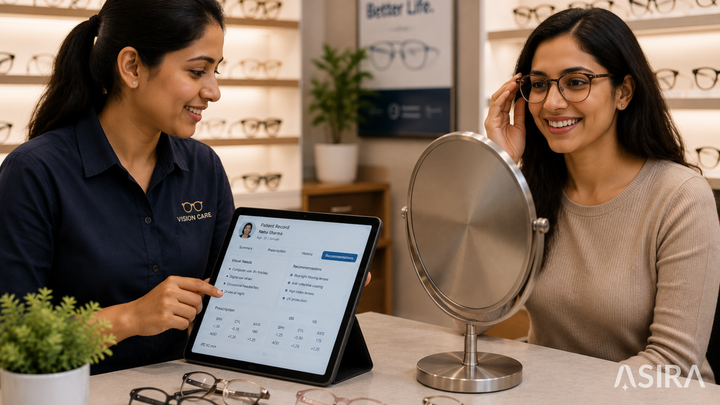
Technology can help make this possible. Imaging, electronic clinical records, digital referral systems, teleconsultation and decision-support tools can allow smaller practices to become better connected to larger healthcare networks. But technology should support clinical practice rather than define it. The most sophisticated diagnostic device is of limited value if the practitioner does not know when to use it, how to interpret the finding or what to do next.
The next phase of Indian optometry
The transition from optical shop to primary eye-care centre will not happen everywhere at the same speed. India is too diverse for a single model to work across every city, town and village. But the direction of travel is becoming clearer. The five-year optometry programme is raising expectations around education and clinical preparation. The NCAHP framework is providing a stronger foundation for professional regulation. Vision-centre models have demonstrated that primary eye care can be connected effectively to secondary and tertiary services. Technology is making sophisticated assessment and remote collaboration increasingly practical. And a younger generation of optometrists is entering the profession with broader ambitions.
The challenge now is to bring these developments together. India does not simply need more people who can refract eyes. It needs more accessible, competent and connected primary eye-care professionals who can identify problems early, manage what they are trained to manage and refer appropriately when a patient needs higher-level care. That is a very different vision of the optical practice.
The future Indian optometry practice may still have frames on the wall, a dispensing table and a lens catalogue. But behind that familiar environment there may also be a clinical record, an OCT, retinal imaging, a structured referral pathway and an optometrist thinking not only about what prescription a patient needs, but about what their eyes need.
The optical shop is not disappearing. It is growing up. And if the profession gets this transition right, the next generation of Indian optometrists could help move primary eye care much closer to where it has always needed to be: in the community, within reach of the patient, and connected to the rest of the healthcare system.


Comments ()