

Understanding Spectacle Prescriptions, Lens Selection & Dispensing
Learn how spectacle prescriptions influence lens selection, effective power, induced prism and dispensing accuracy. A practical guide for optical professionals.

A spectacle prescription is the starting point for lens dispensing, but it does not tell the whole story. Two prescriptions with similar powers may present very different dispensing challenges, while two patients with identical prescriptions may require entirely different lens designs because of their visual demands, frame choices and working environments.
For optometrists and optical dispensing professionals, understanding a prescription means more than accurately transcribing sphere, cylinder, axis and addition. It means anticipating how the prescribed correction will behave when incorporated into a spectacle lens, how the frame and fitting parameters may influence its performance, and what to investigate when a patient does not see comfortably through the finished spectacles.
This article explores the optical principles behind prescription interpretation and their practical implications for lens selection, dispensing and troubleshooting.
1. Prescription transposition and verification
Plus-cylinder and minus-cylinder notation represent different forms of the same spherocylindrical correction. Being able to transpose a prescription is useful when comparing prescriptions from different sources, checking lens orders and verifying finished spectacles.
The transposition follows three steps:
- Add the sphere and cylinder algebraically to obtain the new sphere.
- Reverse the sign of the cylinder.
- Rotate the axis by 90°, keeping it within the 1° to 180° convention.
The prescription has not changed optically. Only its notation has changed.
What should be checked during verification?
When comparing a prescription with a lens order or lensometer reading, the dispensing professional should establish that the values are expressed in compatible formats before concluding that a discrepancy exists.
A plus-cylinder prescription and its minus-cylinder equivalent will have different sphere, cylinder and axis values despite describing the same correction. Comparing the individual numbers without transposition can therefore lead to an incorrect assessment.
Other checks include:
- Confirming right-eye and left-eye assignments.
- Checking that the axis has been transcribed correctly, particularly when cylinder power is substantial.
- Verifying the addition and any prescribed prism.
- Confirming that the ordered lens design and other specifications match the intended prescription.
- Investigating any ambiguity with the prescriber before fabrication or dispensing.
Transposition is a method of expressing a known correction equivalently, not a substitute for prescription verification.
2. Vertex distance and effective lens power
One important consideration in higher prescriptions is vertex distance, the distance between the back surface of a spectacle lens and the corneal reference plane.
Moving a lens closer to or farther from the eye changes its effective power at the eye. This becomes increasingly relevant as lens power increases.
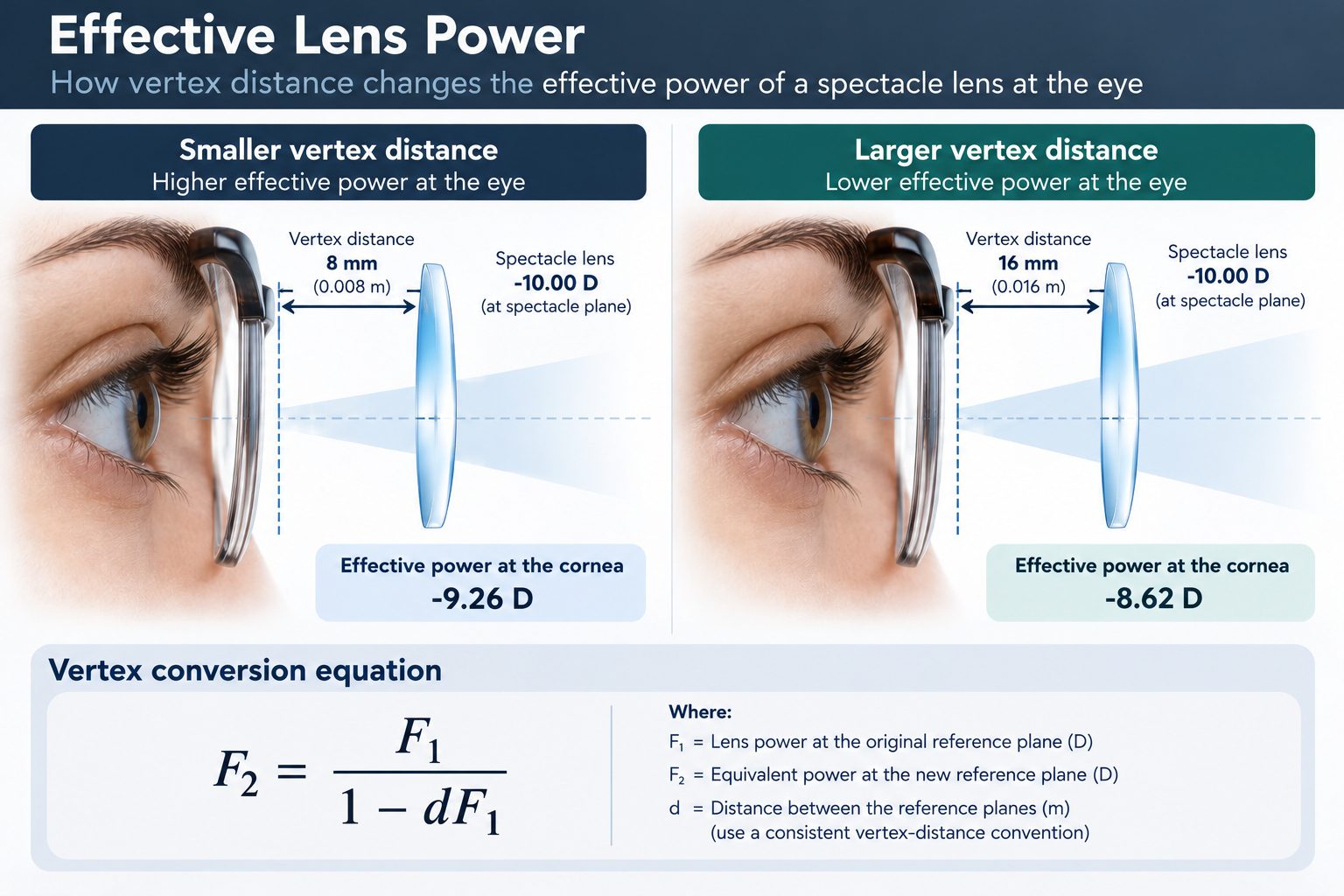
The equation describes how the effective power changes when the reference plane changes. It is particularly relevant for high-powered lenses, where relatively small changes in vertex distance can have a meaningful optical effect.
Implications for lens selection
Vertex distance deserves particular attention when dispensing high-powered lenses, especially when a substantial change in frame position is expected.
For example, replacing a close-fitting frame with one that sits considerably farther from the eye may change the effective correction. The effect is generally more important in higher prescriptions than in low-powered lenses.
For significant powers, optometrists and dispensing professionals should consider:
- The vertex distance used during refraction, where known.
- The expected vertex distance of the new frame.
- Whether a compensated prescription is indicated.
- The effects of changes in frame tilt and wrap.
- Whether the patient is likely to notice a difference in visual performance.
For spherocylindrical prescriptions, the situation is more complex because the principal meridians have different powers. Appropriate meridional calculations or specialist dispensing software may be needed rather than applying a spherical conversion indiscriminately.
3. Cylinder, axis and oblique astigmatism
Cylinder power and axis should always be considered together. The cylinder describes the difference in power between the principal meridians, while the axis describes their orientation in the prescription notation.
Errors in either component can affect the quality of the correction. However, the consequences depend on the cylinder magnitude, the size of the error and the patient's visual requirements.
Why axis accuracy matters
An axis transcription error can introduce a meaningful change in the astigmatic correction, particularly in prescriptions with higher cylinder power.
The axis specifies the orientation of the cylindrical correction. An incorrect axis changes the orientation of the correction and can produce residual astigmatic blur.
This is why a systematic check of the axis is important during ordering and lens verification, rather than relying solely on the sphere and cylinder values.
When lens tilt and wrap become relevant
A spectacle lens is not always worn in the same orientation in which its power was measured. Pantoscopic tilt, face-form wrap and vertex distance can influence the effective correction, particularly in higher-powered lenses.
Oblique viewing through a lens can also introduce unwanted astigmatic effects. The magnitude and direction of these effects depend on lens power, lens geometry, orientation and the angle involved.
These factors become particularly relevant when:
- A high-powered prescription is fitted into a strongly wrapped frame.
- The frame sits at an unusual pantoscopic angle.
- A patient reports blur or distortion after changing frame styles.
- A lens performs differently from what would be expected from its measured prescription alone.
The appropriate response is not necessarily to change the prescription. First, check the lens fabrication, centration, frame adjustment and wearing position. Where indicated, consider whether the effective power in the worn position needs to be assessed.
4. Anisometropia and binocular comfort
Anisometropia refers to a difference in refractive power between the two eyes. The difference may involve spherical power, cylindrical power or both.
Although spectacle correction may provide clear monocular vision in each eye, the difference between the two lenses can introduce additional considerations for binocular comfort.
Differences in spectacle magnification
When the two eyes require substantially different lens powers, the spectacle lenses may produce different image sizes. This can contribute to aniseikonia, a difference in perceived image size between the eyes.
The effect is influenced by more than prescription power alone. Lens shape, thickness, refractive index, base curve, vertex distance and the position of the optical reference points can all influence spectacle magnification.
Consequently, selecting a higher-index lens does not automatically eliminate image-size differences. Lens design and geometry should be considered alongside material choice.
What should the dispensing professional consider?
For patients with significant anisometropia, consider:
- The magnitude and type of the refractive difference.
- Whether the patient has previously worn spectacles with a similar correction.
- Frame dimensions and lens positioning.
- Potential differences in spectacle magnification.
- The patient's binocular vision, symptoms and adaptation history.
- Whether an alternative correction, including contact lenses, warrants clinical consideration.
Contact lenses may reduce some spectacle-related magnification differences because they sit much closer to the eye, although they do not guarantee binocular comfort in every case.
For patients who report persistent discomfort, diplopia or difficulty adapting to a new prescription, the optometrist should investigate the clinical and optical causes rather than assuming that the problem will resolve with time.
5. Applying Prentice's rule to centration and induced prism
Prentice's rule provides a practical way to calculate the prism induced when a patient looks through a point away from the optical centre of a lens.
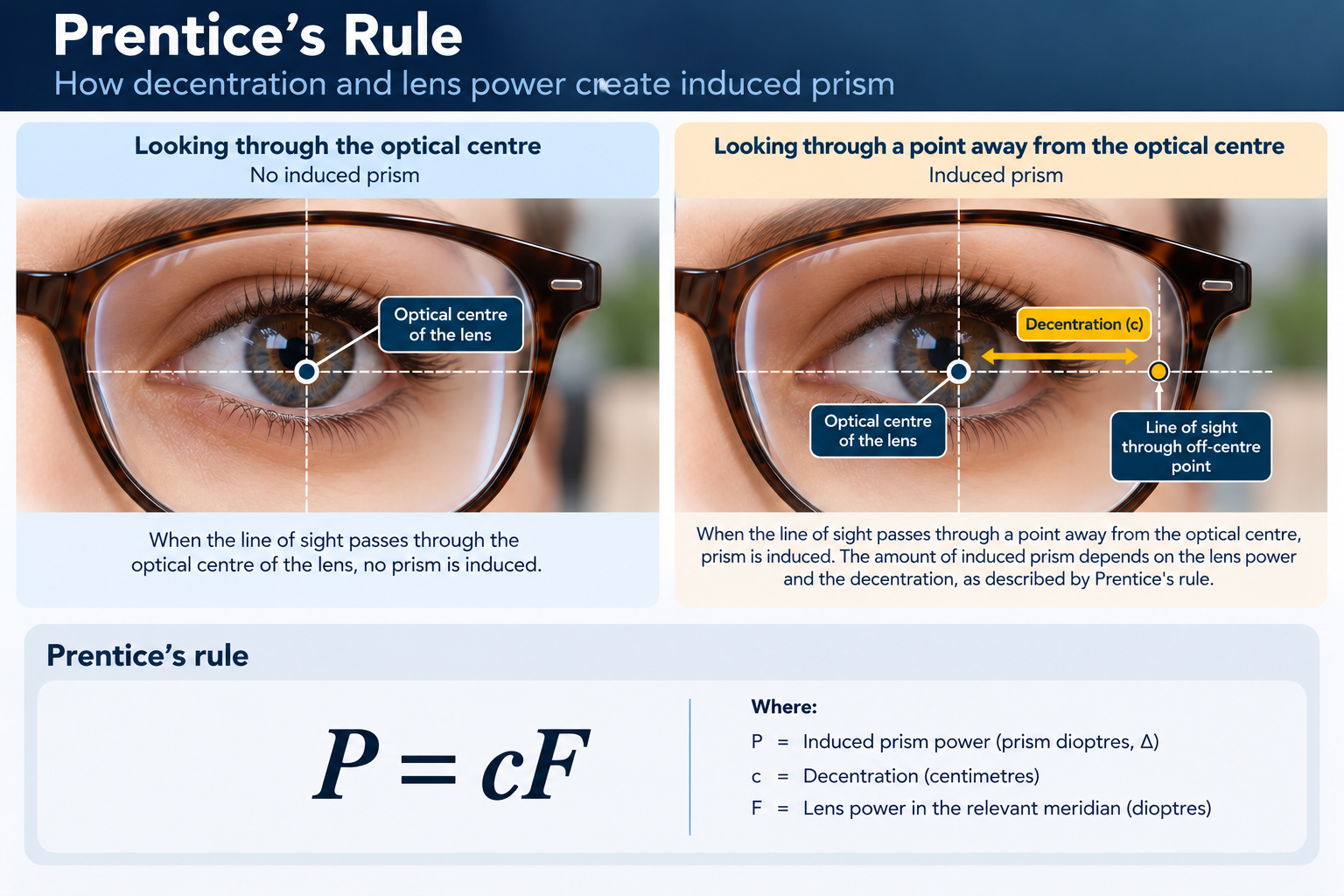
The formula quantifies the relationship between lens power and decentration. For a given displacement, higher lens powers induce more prism. Conversely, even relatively low-powered lenses can induce prism if the decentration is sufficiently large.
The direction of the induced prism depends on the lens power and the direction of decentration.
For a spherocylindrical lens, the calculation must use the appropriate power in the relevant meridian. Where horizontal and vertical decentrations are both present, their effects should be evaluated in the corresponding meridians rather than treating the lens as purely spherical.
Practical implications
Centration is particularly important when dispensing:
- High-powered lenses.
- Prescriptions containing substantial prism.
- Progressive addition lenses with specific fitting requirements.
- Prescriptions in which induced prism may be clinically significant.
The relevant centration requirements depend on the prescription, frame, lens design and applicable dispensing standards.
If a patient reports discomfort or binocular symptoms, checking centration and induced prism can be an important part of the investigation. However, not every symptom is caused by decentration, so the findings must be interpreted in the context of the complete clinical picture.
6. Addition power and lens design
The near addition is an important part of presbyopic correction, but it should not be treated as the sole determinant of lens design.
A patient with a particular addition may require a very different solution from another patient with the same addition, depending on working distances, occupational tasks, posture and the need to see at a distance.
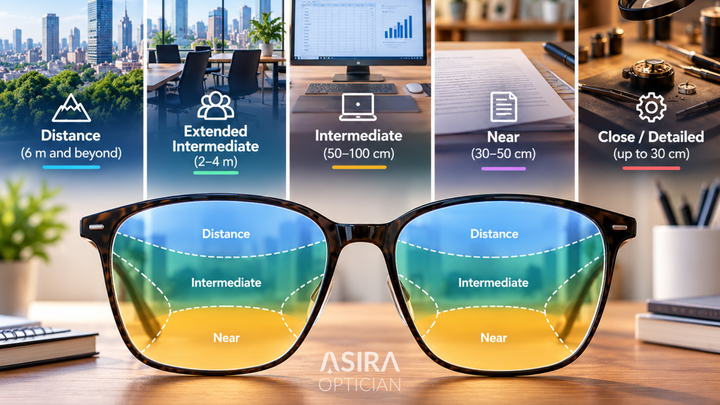
For example, a patient who works primarily at a desktop computer may benefit from an occupational lens with a broad intermediate and near range. Someone who frequently alternates between distance, intermediate and near tasks may be better suited to a general-purpose progressive design.
The choice should reflect the actual visual demands, not simply the magnitude of the addition.
Fitting height and usable viewing zones
For progressive addition lenses, accurate fitting measurements are essential to position the intended viewing zones appropriately in front of the eyes.
A lens can be manufactured to the correct prescription yet perform poorly if the fitting height, monocular pupillary distances or frame adjustment are incorrect.
The frame must also provide sufficient depth for the selected design and meet the manufacturer's fitting requirements.
When troubleshooting a progressive lens complaint, consider whether the patient can access the distance, intermediate and near zones comfortably. Also assess frame slippage, tilt, vertex distance and the patient's habitual head and eye movements.
The addition may be correct while the dispensing parameters are not.
7. Prescription verification and quality control
A lensometer reading is an important part of quality control, but verifying sphere, cylinder and axis alone does not establish that a finished pair of spectacles is correct in every respect.
The dispensing process should include checks appropriate to the order, including:
- Sphere, cylinder and axis, allowing for equivalent prescription notation where relevant.
- Addition power for multifocal and progressive designs.
- Prism power and direction where prescribed.
- Optical centration and relevant fitting measurements.
- Lens material, design and coatings.
- Frame adjustment and the position of the lenses when worn.
Progressive lenses require particular care because the verification reference points are design-specific. Measuring the wrong point or comparing values without considering the manufacturer's specifications can lead to incorrect conclusions.
Verification should follow the relevant standards and tolerances for the product and jurisdiction. Where a discrepancy is identified, it should be investigated before the spectacles are dispensed.
8. Investigating spectacle non-tolerance systematically
When a patient reports that new spectacles are uncomfortable, the prescription should be only one part of the investigation.
Symptoms such as blur, distortion, headache, eyestrain or difficulty with near work can arise from several causes. These may include an incorrect prescription, fabrication errors, inappropriate lens design, inaccurate centration, poor frame adjustment, adaptation difficulties or an underlying clinical problem.
A structured approach helps distinguish between them.
Step 1. Characterise the complaint
Establish when the symptoms occur, whether they affect one or both eyes, which visual distances are involved and whether the patient experiences improvement when removing the spectacles.
Ask whether the symptoms began immediately or developed after prolonged wear. Also establish whether the patient has previously worn a similar prescription or lens design.
Step 2. Verify the finished spectacles
Compare the lenses with the original order and prescription. Check the relevant powers, axis, addition, prism, centration and design specifications.
Do not assume that a correct lensometer reading means the entire dispensing process was correct.
Step 3. Assess frame fit and wearing position
Check frame slippage, tilt, vertex distance and the relationship between the patient's visual axes and the intended lens reference points.
For progressive lenses, verify that the fitting measurements and frame position allow the patient to access the intended viewing zones.
Step 4. Consider the optical explanation
Use the prescription and dispensing measurements to assess whether vertex distance, induced prism, anisometropia, lens tilt or the selected design could plausibly explain the symptoms.
Where the issue involves a complex prescription, appropriate calculations or specialist lens analysis may be needed.
Step 5. Reassess clinically when indicated
If the optical checks do not explain the complaint, or symptoms persist, arrange an appropriate clinical reassessment. Avoid attributing all discomfort to adaptation without excluding significant prescription, binocular vision or ocular causes.
The aim is to identify the cause rather than repeatedly remake lenses without a clear hypothesis.
Conclusion
Understanding a spectacle prescription means understanding how the prescribed correction interacts with lens geometry, frame fit, centration and the patient's visual requirements.
Transposition helps establish optical equivalence. Vertex distance can affect the effective correction in higher powers. Anisometropia may introduce binocular and magnification challenges. Prentice's rule helps quantify the effects of decentration, while addition power and fitting parameters influence the performance of multifocal and occupational lenses.
For optometrists and optical dispensing professionals, these principles are most valuable when applied to real dispensing decisions. They help anticipate problems, select appropriate lens designs, verify finished spectacles and investigate non-tolerance more systematically.
The objective is not simply to reproduce the prescription accurately. It is to ensure that the prescribed correction is translated into spectacles that perform as intended for the person wearing them.
Download the ASIRA Optician App TODAY and start your FREE TRIAL! www.asira.health/optician


Comments ()