

Why Cloud-Based EMRs Are Becoming Essential in Eye Care
Cloud-based EMRs are redefining modern eye care by improving access, security, collaboration, and clinical efficiency. Here is how platforms like ASIRA help practices move toward a smarter, patient first future.
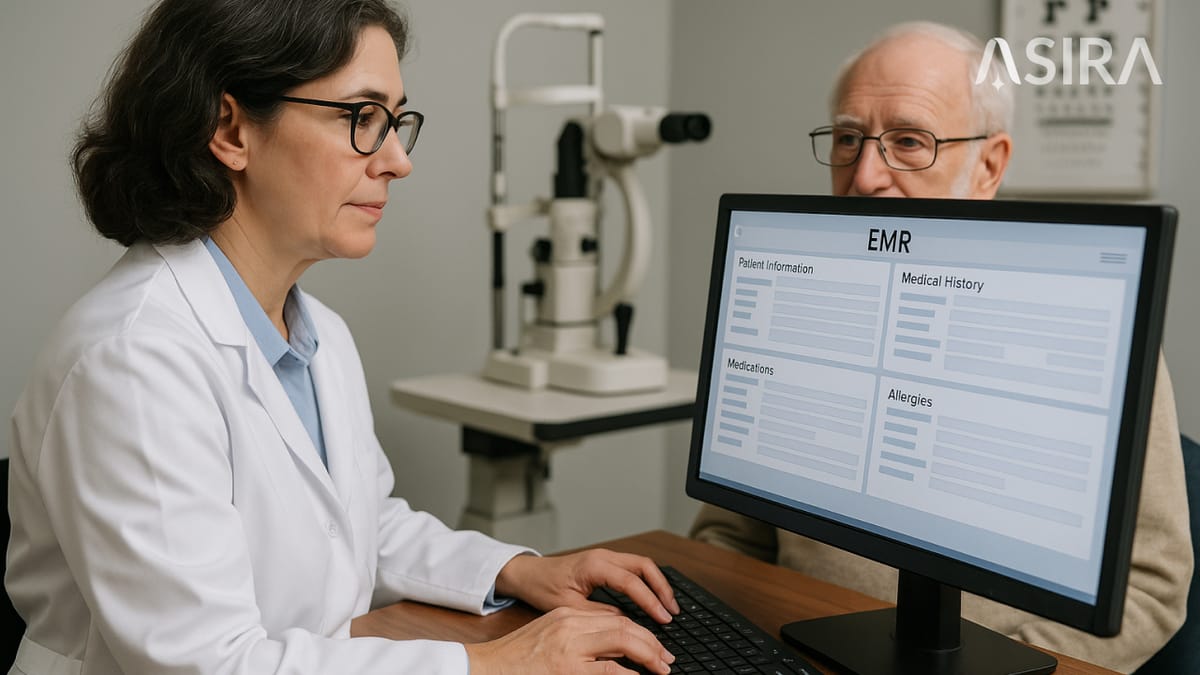
The move to digital in eye care is no longer about swapping paper for a screen. It is about making daily work easier, keeping teams in sync, and supporting care that often happens across locations and time. Cloud-based EMRs sit at the center of this shift. They change how we access records, how we coordinate between rooms and branches, and how we keep the patient journey consistent from the first visit to long term follow up.
This is not a passing fad. It is the same kind of shift we saw when OCT became routine or when myopia management moved from interest to standard of care. The real question is not whether to adopt a cloud EMR. It is how to pick one that respects clinical reality and supports the way your practice works.
Why practices are moving to the cloud
1) Access from anywhere
There will always be a time when you need a record outside clinic hours. A patient calls with symptoms after a procedure, a surgeon needs to double check a biometric value before a case, or a colleague asks for quick input during an outreach camp. With a cloud EMR, records are available securely on any approved device. You get what you need in seconds, and you make a better decision because you are working with the full history, not guesswork.
2) Security that meets healthcare standards
Cloud does not mean less control. A well designed cloud EMR uses encryption in transit and at rest, role based access, and audit trails for every change. It should provide automatic, redundant backups and disaster recovery so one failed hard drive never becomes a crisis. Compliance frameworks such as HIPAA and GDPR exist for a reason. Good vendors build around them from day one. In practical terms, this means fewer sleepless nights over lost data and a much lower risk of a privacy incident.
3) Grows with the practice
Adding a room, a device, or a new branch often becomes a tangle of cables and local servers. Cloud systems scale without new hardware. You turn on the features you need, add users as you grow, and avoid the cycle of buying, maintaining, and replacing machines that age faster than you would like. Cost becomes more predictable, and your clinical team does not become an unofficial IT department.
4) Built for teamwork
Eye care is collaborative by design. Optometrists, ophthalmologists, counselors, and optical staff all touch the same patient journey. A cloud EMR lets everyone see the same record in real time. Refractions, diagnostics, scheduling, counseling notes, and billing are no longer scattered between systems or spreadsheets. That reduces duplicate entry and avoids small mistakes that become big issues at checkout or during postoperative follow up.
ASIRA, made for eye care
Generic EMRs try to cover every specialty and end up feeling heavy in the areas that matter most to us. ASIRA is built for eye care first. The exam flow looks like the way we work, not like a form built for a different specialty.
Key capabilities you actually use
- Clinical documentation that fits the exam. Refraction, anterior and posterior segment findings, imaging summaries, measurements for cataract planning, and perioperative notes are structured in a way that makes sense in clinic.
- Diagnostic device integrations. OCT, fields, topography, and other imaging can be captured into the record so you track progression over time without manual imports.
- Billing, inventory, and optical. Clinical recommendations tie to dispensing and pharmacy when needed, which keeps your financials aligned with your clinical decisions.
- Task and team management. Assign work, track completion, and notify the right person at the right time so handoffs do not fall through the cracks.
- Secure patient communication. Reminders and follow ups can be sent from within the EMR so you are not juggling external tools.
What changes in day to day practice
Better clinical decisions
When you can see years of pressure readings, a sequence of macular scans, and the lens choice used in the fellow eye, your decision is sharper. It is faster as well because you are not hunting through email attachments or old folders.
Less time on admin
Automated billing, inventory sync, templated documentation, and appointment reminders cut down the repetitive work that eats up hours. That time comes back to the chair, to councilling, and to staff training.
Resource visibility
With a unified system, you can see which clinics are running behind, which devices are underused, and which frames or lenses move fastest. It becomes easier to plan instead of reacting week by week.
Support for tele optometry and outreach
Remote reviews, postoperative check ins, and secondary opinions become practical. Records are already in the system, and your documentation stays consistent whether the encounter is in person or virtual.
Challenges to plan for, and how to handle them
- Data migration. Moving from paper or a legacy EMR needs a plan. Start with a clear cut off date, bring forward active and recent patients first, and archive older charts in a searchable format. Run both systems in parallel for a short, defined period, then switch fully.
- Internet reliability. A stable primary connection is important. Keep a backup option available and test it, for example a 4G or 5G hotspot with enough bandwidth for your busiest hour.
- Training and adoption. Even an intuitive system benefits from structured onboarding. Give each role a short, focused checklist. Identify a super user in each location who can answer quick questions. After two weeks, collect feedback and adjust templates where needed.
Security, compliance, and trust
Patients trust us with sensitive information over long timelines. A cloud EMR should make that trust easier to honor, not harder.
- Encryption. Data should be encrypted at rest and in transit. Ask how keys are managed and rotated.
- Access control. Use role based permissions. Reception does not need surgical planning, and theater staff do not need access to financial reports.
- Audit trails. Every view and change should be logged with user, time, and action.
- Backups and disaster recovery. Ask about recovery time and recovery point objectives. Know how quickly you would be back online and how much data, if any, could be at risk in a worst case event.
- Vendor transparency. Look for clear documentation, regular security updates, and third party assessments.
Costs, but in real terms
The price tag on a server often looks cheaper until you count the hidden items. Local machines need power, cooling, physical space, backup drives, antivirus, and a person who knows what to do when something fails. Cloud subscriptions include hosting, backups, updates, and support. Over three to five years, the total cost of ownership often favors the cloud, and the operational risk is lower.
A simple migration plan
- Prepare your data. Export what you can from your current system. Decide what moves to the new EMR and what gets archived. Clean the obvious duplicates.
- Set up roles and templates. Build exam templates, counseling notes, and billing items by role. Keep it simple at first, then refine.
- Train, then soft launch. Run one full day with a smaller schedule. Capture feedback and fix friction points. Do not skip this step.
- Go live and review. Switch fully, monitor the first two weeks closely, and make small, quick improvements rather than big overhauls.
How to evaluate a cloud EMR for eye care
- Does the exam flow feel natural for your practice type, for example comprehensive, cataract, glaucoma, cornea, pediatrics, or contact lenses
- Can it pull in imaging from the devices you own today
- Can you build templates quickly without a ticket to support
- Are billing and inventory aligned with how your optical or pharmacy operates
- What is the plan and timeline for migration, training, and go live
- What are the uptime commitments and the support response times
- What does the roadmap look like for the next year, and does it match where you are heading
The near future
- AI assistance. Triage alerts, risk scores for progression, and suggested follow ups that respect clinical judgment rather than replace it.
- Interoperability. Cleaner exchange of data with labs, imaging networks, and referral partners so the EMR becomes a hub, not a silo.
- Patient participation. Portals that give patients access to their prescriptions, instructions, and reports, which reduces calls and improves adherence.
Conclusion
Cloud-based EMRs have moved from nice to have to necessary. They give teams the information they need, when they need it, and they take away a lot of the friction that slows down good care. For eye care, the best systems are the ones that understand our exam flow, our imaging heavy records, and the way our clinics really run.
ASIRA was built with that reality in mind. It supports the clinical work first, then it brings the operations along with it. The result is a practice that feels more coordinated, more resilient, and more ready for what comes next.
ASIRA is a cloud-based EMR and practice management software built by eye care professionals for eye care professionals. We have helped hundreds of practices change the way they work. Try it for FREE yourself with our 30-Day Free Trial.


Comments ()